-
We detected your language preference as English. Would you like to switch to the English version for a better experience?
Switch to English
Stay here



In just under 100 days of his second presidential term, Donald Trump has already stirred up a storm in America's scientific community.
For example, under the new administration's proposals, NASA's $7.6 billion research budget may be slashed by nearly half. The pharmaceutical industry, however, is facing even stronger and more intense blows.
On the day of his inauguration, Trump issued an executive order banning any U.S. federal funding related to diversity, equity, and inclusion (DEI). As a doctor and researcher, Rebecca Simmons was shocked. This unprecedented turmoil in her over fifty-year career posed a huge threat to public health.
Simmons had long wanted to understand why African American women were more likely to experience complications during pregnancy, including stillbirths, hypertension, and preterm births. However, under Trump's ban, applying for funding from the National Institutes of Health (NIH) became more difficult.
"The inability to conduct research has far-reaching consequences," Simmons stated. "Ignoring the health disparities faced by vulnerable groups, and failing to understand the reasons behind these disparities, will put these groups at an extremely high risk of worsened health outcomes."
Since World War II, U.S. government-funded scientific research has been one of the engines of discovery and global economic growth. The turbulence in the research field is particularly damaging to industries like pharmaceuticals, as innovative drugs are often built on publicly funded research. A study cited by former NIH Director Francis Collins shows that between 2010 and 2019, over 99% of approved drugs were funded by the NIH.
Even if Trump's policies are softened or reversed, the effects may be long-lasting. The new administration's actions have shaken the widely held belief of the past decades that the U.S. offers a solid, well-funded, and open research environment.
Moreover, there is no clear sign that such policies will be softened or reversed. Quite the opposite, in March, Trump openly challenged the constitutional boundaries, claiming that his pursuit of a third presidential term "was no joke." If Trump returns to the White House after 2028, the shadow over the U.S. pharmaceutical industry may continue to loom.
Furthermore, this disruptive effect may accelerate the outflow of innovation resources, reshaping the position of countries like China in the global market.
Many life sciences institutions are already in chaos, including the NIH, which employs about 20,000 people.
Starting as a single laboratory in the 19th century, the NIH has grown into a biomedical giant. In 2022, the NIH provided $33 billion in research funding to the pharmaceutical industry—25 times more than the second-largest funder, the Wellcome Trust.
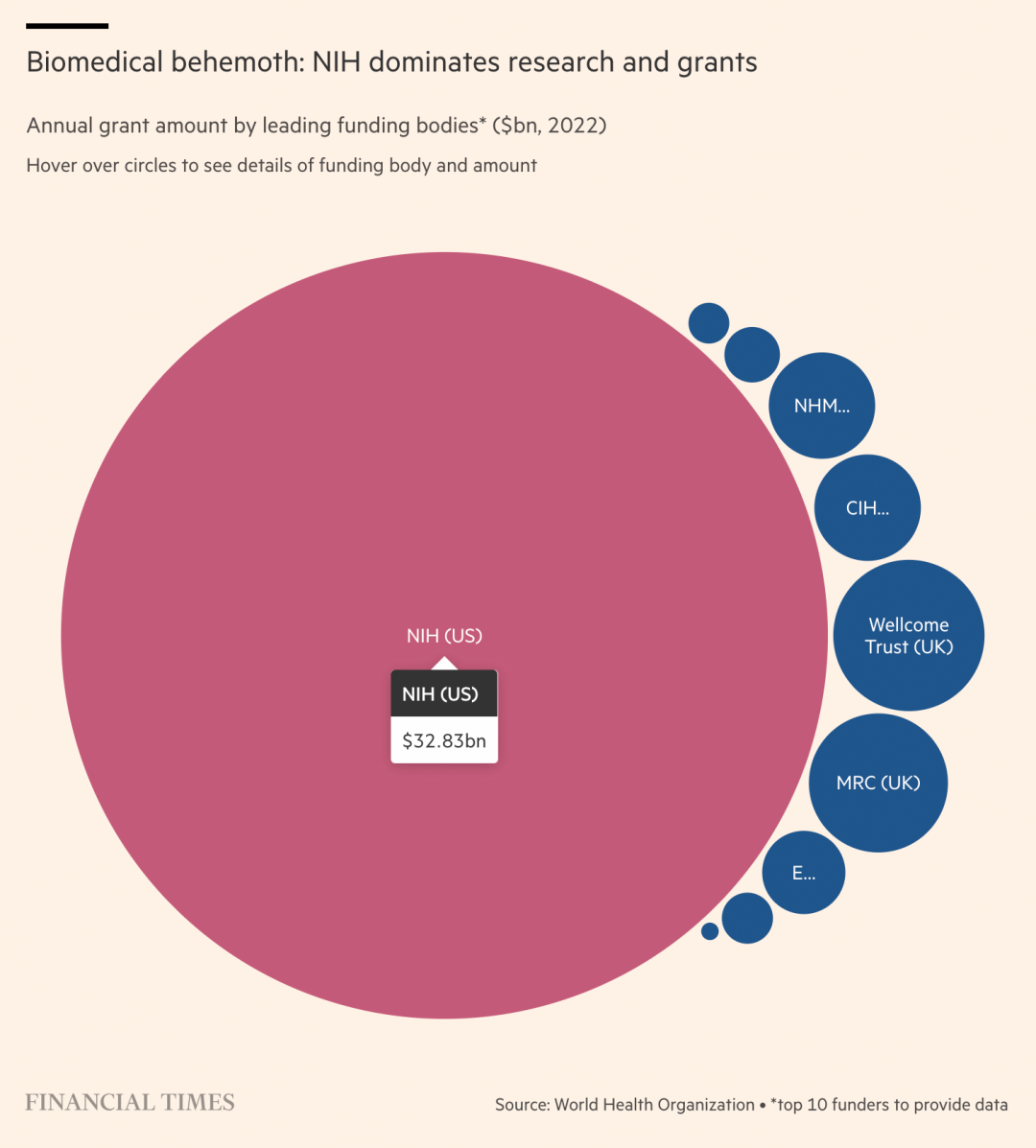
Under the NIH's funding, breakthroughs in gene editing and mRNA technology have been pushed into clinical trials and the market. According to a study published in March, every $1 spent by the NIH generates $2.56 in new economic activity within the U.S.
Media reports initially indicated that the Trump administration plans to cut NIH’s annual funding of $47 billion by about 40%. The NIH has already announced that it will reduce its billions in annual grants to researchers.
Currently, the U.S. Department of Health and Human Services (HHS), which manages the NIH, is led by Robert F. Kennedy, a long-time vaccine skeptic. Since then, HHS has fired about 1,200 NIH employees, with others reassigned or placed on leave, and a small number have returned to their positions.
The NIH has also become politically symbolic due to its association with Dr. Anthony Fauci, who was the public face of the White House COVID-19 Task Force. Fauci sometimes contradicted Trump's statements on the virus, making him a target of disdain among certain supporters of the "Make America Great Again" movement, with Elon Musk calling for his prosecution.
In December 2022, Fauci stepped down from his position as director of the National Institute of Allergy and Infectious Diseases (NIAID) and as the president's chief medical advisor. Shortly after Trump took office, Fauci's security detail was withdrawn.
Insiders revealed that senior NIH officials, including Fauci’s allies and colleagues, are facing reassignment. Fauci's wife, Dr. Christine Grady, head of the NIH Clinical Center's Department of Bioethics, has been threatened with demotion and placed on administrative leave. Fauci’s successor, NIAID Director Dr. Jeanine Marazzo, is facing a similar fate.
Ideologically driven conflicts are consuming other health institutions as well. In March, Peter Marks, who resigned as FDA's vaccine chief, accused Kennedy of spreading "misinformation and lies" about vaccines. Meanwhile, the new HHS head has canceled initiatives aimed at eliminating vaccine hesitancy.
"Anti-science" sentiments are brewing. Reports state that Kennedy has hired David Gale, a long-time vaccine critic who was previously penalized for practicing medicine without a license. Gale has long propagated the debunked theory that vaccines are linked to autism. Kennedy has promised to find the "cause of the autism epidemic" by September, raising public alarm.
Some critics of the government have compared these "purges" to the McCarthyism of the 1950s, when public figures accused of sympathizing with communism were persecuted. However, Mary Sue Coleman, former president of the University of Michigan, believes that even this comparison does not fully capture the nature of the current situation.
"For me, this feels like an almost unprecedented era," Coleman remarked.
As noted by Sven Lidin, the incoming president of the Royal Swedish Academy of Sciences, "Science perhaps more than anything else depends on predictable, stable conditions."
The huge gap left by the reduction of U.S. research funding is unlikely to be filled by companies or charitable organizations—they neither have the willingness nor the capacity.
Jeremy Levin, a board member of the Biotechnology Innovation Organization (BIO) and CEO of a biotech company, compared NIH funding to the U.S. interstate highway system. Although the highways are built by the federal government, without them, no industry could function.
"History tells us that basic science is the foundation of all medicines," Levin pointed out. From hypertension treatments to immune-based cancer drugs, these therapies rely on decades of government-supported research.
In the long term, the lack of a stable research environment could have "serious consequences." Many believe that over time, patients and their families will bear the brunt of it.
Daniel Diermeier, president of Vanderbilt University in Kentucky, stated that Alzheimer's patients depend on research conducted in university labs. "If funding is reduced, drug development will decline," he said, "and that cannot be compensated for by private funding. It’s not possible. The funds aren’t enough."

Moreover, even though Trump's second term has just begun, the aftershocks of suppressing science have already far exceeded U.S. borders.
Levin analyzed that spending cuts may lead excellent professionals to move abroad to more attractive locations, ultimately causing the U.S. to lose its scientific leadership to countries like China.
China has made significant strides in fields like materials science and quantum communication, largely due to national investment. Critics argue that from a geopolitical perspective, limiting U.S. research is reckless, especially as Trump challenges China in other areas (especially trade).
Other countries' institutions have begun to proactively offer safe havens for concerned U.S. researchers. Meanwhile, foreign scientists are hesitant to come to the U.S. due to incidents like a French researcher being denied entry for criticizing Trump's science policies.
U.S. and global pharmaceutical industries for years, also believes that these events under Trump could lead to the following outcome: some Chinese-American scientists working in bioresearch in the U.S. may lose their jobs or choose to return to China, bringing back the experience, knowledge, and projects they have acquired abroad, thus contributing to the development of China's innovative drug industry and benefiting the initiation of innovative drug projects in China.
However, challenges will arise as well.
The decoupling movement led by the Trump administration has spread to the scientific field. Against this backdrop, mergers and acquisitions (M&A), and even the rise of NewCo in the past year, are likely to face uncertainty. As a result, the number of Chinese companies engaging in overseas transactions may decrease, and the standards for selecting transaction targets may become stricter.
To some extent, the protests are growing louder.
In March, nearly 2,000 researchers—including dozens of Nobel laureates—signed an open letter. The letter read: "We see the real danger at this moment. We are sending out this distress signal to issue a clear warning: the nation’s scientific enterprise is being badly harmed."
Coleman stated that universities are the "source" of commercial scientific research, but she hasn't heard many CEOs defend them: "I wish more companies would stand up and speak out."
Pharmaceutical executives have largely remained silent, fearing strong backlash. They prefer to keep a low profile while trying to address other threats facing the industry, such as tariffs and policies to reduce drug prices. Executives claim they are having private conversations with the government, pointing out the disastrous effects of cutting public research funding on America's global scientific standing.
In addition to commercial companies, some research institutions are also in deep trouble. Scientists are struggling with whether they should openly confront the government or cautiously lobby to meet some or all of its demands.
The founders of the "Defend Science" movement are relatively young researchers, which might explain the situation. For example, Emma Courtney, a Ph.D. student from the nonprofit Cold Spring Harbor Laboratory in New York, said that young scientists are "watching our career paths change in real time."
"Academic success in the long term largely depends on early achievements—grants, scholarships, and key opportunities—and these are exactly the things being cut," Courtney said. "While many senior scientists have given great support, they often face fewer incentives and sometimes even greater risks because they are hesitant to voice their opinions."
Some researchers feel that public sentiment is shifting. However, turning the initial anger over the scientific community's upheaval into mobilized willingness and leadership will take time.
As for the pharmaceutical giants, they too are trying to adjust. And based on their current public actions, they seem to be conforming rather than resisting.
Reductions in FDA and NIH staff and funding, along with escalating trade wars, will pass the pressure onto multinational corporations (MNCs), triggering a new round of pipeline reshuffling.
Novartis announced a $23 billion investment plan this month, Johnson & Johnson pledged a $55 billion investment in March, and Eli Lilly committed to a $27 billion investment plan in February.
Since February, Eli Lilly and Johnson & Johnson have promised to build new production facilities in the U.S., with investments of $27 billion and $55 billion, respectively. In April, Novartis also announced a $23 billion investment plan. The latest statement from Roche indicates that they will invest $50 billion in manufacturing and R&D over the next five years.
 EN
EN
 Agricultural News
 Food News
 Industrial News
 Cosmetic News
 Pharmaceutical News
 Science News
