-
We detected your language preference as English. Would you like to switch to the English version for a better experience?
Switch to English
Stay here



Glucagon-like peptide-1 (GLP-1) receptor agonists and co-agonists, collectively known as GLP-1 drugs — such as liraglutide, dulaglutide, semaglutide, and the GLP-1R/GIPR co-agonist tirzepatide — were initially developed to treat type 2 diabetes (T2D) because they increase insulin secretion, reduce glucagon secretion, and slow gastric emptying by acting on the pancreas and brain. In addition, activation of GLP-1R/GIPR in the brain lowers appetite and promotes satiety, supporting their use in weight loss. Currently, liraglutide, semaglutide, and tirzepatide are approved for the treatment of type 2 diabetes, obesity, and related conditions.
In fact, beyond their well-established glucose-lowering and weight-reducing effects, GLP-1 drugs also reduce the incidence of chronic kidney disease, myocardial infarction, stroke, and cardiovascular death in type 2 diabetes patients; they also improve symptoms and prognosis in patients with heart failure with preserved ejection fraction (HFpEF). Moreover, clinical trials have shown benefits for metabolic dysfunction-associated steatotic liver disease (MASLD), obstructive sleep apnea (OSA), and osteoarthritis (OA).
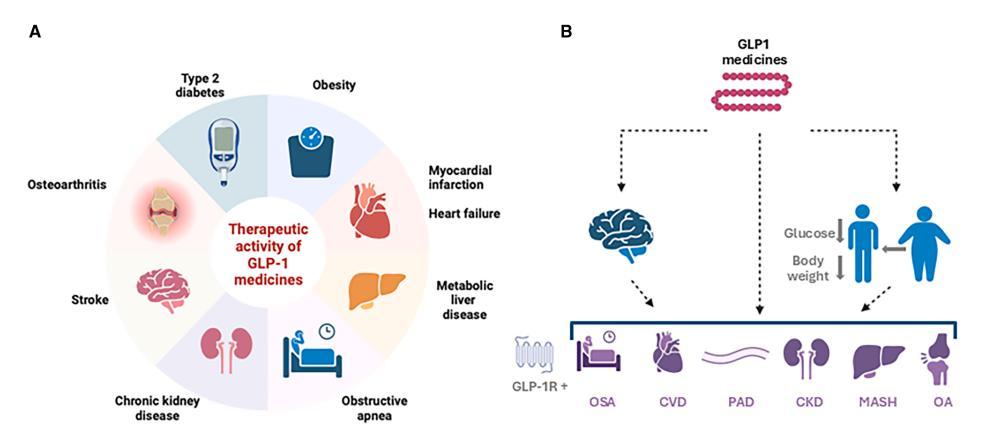
On July 15, 2025, Daniel J. Drucker — a pioneer in GLP-1 research — published a review article titled The Expanding Benefits of GLP-1 Medicines in Cell Reports Medicine, a Cell journal sub-publication. The article summarized evidence that GLP-1 drugs have beneficial effects beyond type 2 diabetes and obesity, reaching phase 3 clinical trials for conditions including cardiovascular disease (CVD), chronic kidney disease (CKD), MASLD, OA, OSA, and peripheral artery disease (PAD).

Daniel J. Drucker is a Canadian endocrinologist renowned for groundbreaking discoveries in GLP-1 and GLP-2 biology, including GLP-1’s key roles in stimulating glucose-dependent insulin secretion, reducing food intake, protecting the heart, and mitigating systemic inflammation.

Daniel J. Drucker
His work transformed GLP-1 from a newly discovered peptide into a globally used, life-changing therapy for type 2 diabetes and obesity. He has received international honors such as the Gairdner Award, Wolf Prize, and Breakthrough Prize in Life Sciences, and is considered a strong Nobel Prize candidate.
In 2024, semaglutide was approved by the US FDA as the first weight-loss drug proven to reduce the risk of major adverse cardiovascular events in adults with obesity or overweight (without type 2 diabetes but with established cardiovascular disease), provided it is combined with a low-calorie diet and increased physical activity. This approval was based on the SELECT trial results, which studied 17,604 patients with a body mass index (BMI) over 27 and a history of myocardial infarction, stroke, or symptomatic peripheral artery disease. Over a median follow-up of 34.2 months, weekly subcutaneous injections of 2.4 mg semaglutide significantly reduced the primary composite endpoint incidence of nonfatal myocardial infarction, nonfatal stroke, or cardiovascular death (6.5% in the semaglutide group vs. 8% in placebo; hazard ratio 0.8). Additionally, semaglutide lowered all-cause mortality, a key secondary endpoint (4.3% vs. 5.2%; hazard ratio 0.81). Notably, these benefits were independent of the degree of weight loss.
A meta-analysis of clinical trials assessing HFpEF patients—including STEP HFpEF, STEP HFpEF DM, FLOW, and SELECT trials—showed that semaglutide improved NYHA class II-IV symptoms, physical activity limitations, and exercise capacity, while reducing N-terminal pro-brain natriuretic peptide levels by 30%. The composite endpoint of cardiovascular death and heart failure-related intensified therapy or hospitalization dropped by 31% (hazard ratio 0.69).
The FLOW trial studied 3,533 adults with an average BMI of 32 who had type 2 diabetes and chronic kidney disease. After 3.4 years of follow-up, weekly subcutaneous injections of 1 mg semaglutide reduced the incidence of a composite outcome including renal failure events, sustained ≥50% decline in eGFR, or death due to kidney or cardiovascular causes (23.2% placebo vs. 18.7% semaglutide; hazard ratio 0.76). Based on these results, in January 2025, the US FDA expanded semaglutide’s approved indications to reduce the risk of kidney disease progression, renal failure, and cardiovascular death in adults with type 2 diabetes and chronic kidney disease.
The SOUL trial evaluated the cardiovascular safety of oral semaglutide in type 2 diabetes patients. Results further confirmed the cardio-renal benefits of GLP-1 drugs, with or without concurrent SGLT2 inhibitor (SGLT2i) use. This placebo-controlled trial enrolled over 9,600 patients with type 2 diabetes and atherosclerotic cardiovascular disease, chronic kidney disease, or both. Compared to placebo, daily maximum dose oral semaglutide (14 mg) reduced the relative risk of major adverse cardiovascular events by 14% (hazard ratio 0.86) over an average follow-up of 47.5 ± 10.9 months. The effect was consistent across subgroups, including those receiving SGLT2i. Oral semaglutide also lowered the incidence of several predefined secondary outcomes, including cardiovascular death (hazard ratio 0.93), a composite of five major kidney disease outcomes (hazard ratio 0.91), and two composite major adverse limb events (hazard ratio 0.71). The overall safety profile was consistent with previous trials. These cardio-renal benefits observed regardless of SGLT2i use further underscore the therapeutic value of semaglutide and GLP-1 drugs for comprehensive cardio-metabolic care in type 2 diabetes.
In a 240-week phase 3 clinical trial involving 1,200 adults with metabolic dysfunction-associated steatohepatitis (MASH) and fibrosis stages F2-F3 (average BMI 34.6), the first 800 participants receiving weekly 2.4 mg semaglutide for 72 weeks showed histological liver improvements. Compared to placebo, semaglutide increased MASH resolution rates (63% vs. 34%) without worsening liver fibrosis, and reduced fibrosis (37% vs. 23%) without aggravating MASH. Additional safety and efficacy results are expected in 2029. Because hepatocytes do not express GLP-1 receptors, semaglutide’s benefits may be secondary to weight loss or reflect indirect local or systemic effects on liver metabolism and inflammation.
In a 48-week phase 2 trial treating 293 participants (mean BMI=36) with metabolic dysfunction-associated steatohepatitis, Survodutide (a dual GCGR and GLP-1R agonist) improved MASH in 62% of participants with no fibrosis worsening, compared to only 14% improvement in the placebo group. Additionally, a 52-week phase 2 trial using the GIPR/GLP-1R co-agonist tirzepatide demonstrated weight loss and reduced MASH extent without fibrosis progression. Greater weight loss correlated with higher rates of MASH resolution and no fibrosis worsening, though the association with fibrosis reduction was less clear.
The STEP 9 trial enrolled 407 patients clinically and radiologically diagnosed with moderate knee osteoarthritis and at least moderate pain, with BMI ≥30. Over 68 weeks, weekly 2.4 mg semaglutide treatment reduced WOMAC pain scores (range 0–100, higher scores indicating worse pain) by 41.7 points compared to a 27.5-point reduction with placebo. Semaglutide induced a 13.7% weight loss versus 3.2% in the placebo group, likely contributing to some of the observed benefits.
In 2024, based on phase 3 SURMOUNT-OSA trial results, tirzepatide was approved for adults with moderate-to-severe obstructive sleep apnea and obesity. Trial 1 included 234 adults not receiving positive airway pressure therapy at baseline; Trial 2 enrolled 235 adults already on such therapy. Participants were randomized 1:1 to the maximum tolerated dose of tirzepatide (10 mg or 15 mg) or placebo for 52 weeks. At 52 weeks, tirzepatide significantly reduced the primary endpoint—apnea-hypopnea index (AHI). In Trial 1, the tirzepatide group reduced AHI by 25.3 events/hour vs. 5.3 in placebo, with an estimated treatment difference of -20.0 events/hour. In Trial 2, AHI decreased by 29.3 events/hour with tirzepatide vs. 5.5 with placebo, treatment difference -23.8 events/hour.
The STRIDE trial evaluated weekly 1 mg semaglutide in participants aged 18+ with type 2 diabetes and peripheral artery disease (manifested as intermittent claudication and hemodynamic evidence of impaired limb blood flow). At 52 weeks, semaglutide significantly increased maximum walking distance. Notably, semaglutide was associated with about 4 kg weight loss compared to placebo, and increases in walking distance moderately correlated with the degree of weight loss.
GLP-1 drugs reduce stroke incidence, as confirmed by major cardiovascular outcome trials including SELECT, SUSTAIN-6, REWIND, and PIONEER 6. These effects may arise from metabolic improvements; direct central nervous system actions such as regulating neuroinflammation; inhibition of platelet aggregation; reduction of atherosclerosis; vascular protection; and lowering oxidative stress. GLP-1 drugs are also linked to reduced risk of all-cause dementia (including Alzheimer's disease) in type 2 diabetes patients. Ongoing EVOKE and EVOKE+ trials are testing oral semaglutide (14 mg/day) for disease-modifying potential in early symptomatic, biomarker-confirmed Alzheimer's disease. Each trial plans to enroll 1,840 participants treated for 156 weeks. The primary endpoint is change in Clinical Dementia Rating (CDR) score at week 104. Results are expected in 2025, with an extension phase through 2026.
How GLP-1 drugs provide benefits partially independent of weight loss remains unclear. Many chronic diseases targeted by GLP-1 drugs—including cardiovascular disease, chronic kidney disease, MASLD, osteoarthritis, peripheral artery disease, and obstructive sleep apnea—feature dysregulated inflammation, often in the context of insulin resistance and obesity. Insulin resistance itself plays a central pathophysiological role in these diseases and is closely linked to chronic low-grade inflammation. Whether the clinical efficacy of GLP-1 drugs is mainly mediated by weight loss or also involves improvements in insulin sensitivity, metabolic control, and inflammation reduction is unresolved, since most large clinical trials were not designed to clarify underlying molecular mechanisms. Furthermore, major outcome trials have not uniformly analyzed results by the degree of weight loss achieved. Notably, a preliminary report from the SELECT trial investigators suggests that the 20% reduction in primary outcomes does not depend on weight loss extent.

Direct and indirect mechanisms through which GLP-1 medicines reduce disease complications, including reduction of inflammation through inter-organ communication via the brain, direct activation of GLP-1 receptors within multiple organs, and lowering of blood glucosae and body weight.
GLP-1 drugs consistently reduce inflammatory biomarkers in clinical trials and suppress inflammatory responses in animal models and humans, partly independent of weight loss. These immunomodulatory effects manifest as decreases in CRP, TNF-α, MCP-1, MMP-9, SAA, IL-6, and other inflammatory cytokines and oxidative stress markers. Remarkably, semaglutide-regulated circulating proteomics reveal modulation of inflammation-related proteins, partly independent of weight loss.
At least three complementary mechanisms contribute to the anti-inflammatory effects of GLP-1 drugs: direct actions on GLP-1R+ cells in joints, heart, kidneys, liver, and immune cells; indirect effects via weight loss and glycemic control; and inhibition of inflammation through activation of GLP-1R in subsets of central nervous system neurons via organ cross-talk. GLP-1 may also improve organ health by acting on endothelial and vascular smooth muscle cells controlling local blood flow and immune regulation. The precise molecular mechanisms linking GLP-1 drugs to their broad clinical benefits warrant further study.
The surprisingly wide-ranging benefits of GLP-1 drugs now extend to lowering the incidence of heart failure, stroke, myocardial infarction, diabetic kidney disease, metabolic liver disease, osteoarthritis, peripheral vascular disease, and obstructive sleep apnea. Ongoing trials are exploring applications in substance abuse, psychiatric disorders, and neurodegenerative diseases. More detailed elucidation of GLP-1 drug mechanisms and benefits — potentially partly independent of weight loss and glucose metabolism — may offer new therapeutic opportunities to more precisely target and expand GLP-1 drug use, perhaps even at lower doses with fewer side effects when weight loss is not the primary goal.
While effective dosing ranges for GLP-1 drugs like semaglutide and tirzepatide are established for treating type 2 diabetes and obesity, the dose-response relationship for inflammatory, substance use, or neurodegenerative conditions (e.g., Alzheimer's) remains unclear. In populations with neuropsychiatric disorders, weight loss may be an undesirable outcome. Thus, understanding the dose-response, optimal treatment duration, and key GLP-1 regulatory circuits behind benefits independent of weight loss could open new therapeutic avenues — ideally optimizing both efficacy and tolerability.
 EN
EN
 Agricultural News
 Food News
 Industrial News
 Cosmetic News
 Pharmaceutical News
 Science News
