-
We detected your language preference as English. Would you like to switch to the English version for a better experience?
Switch to English
Stay here



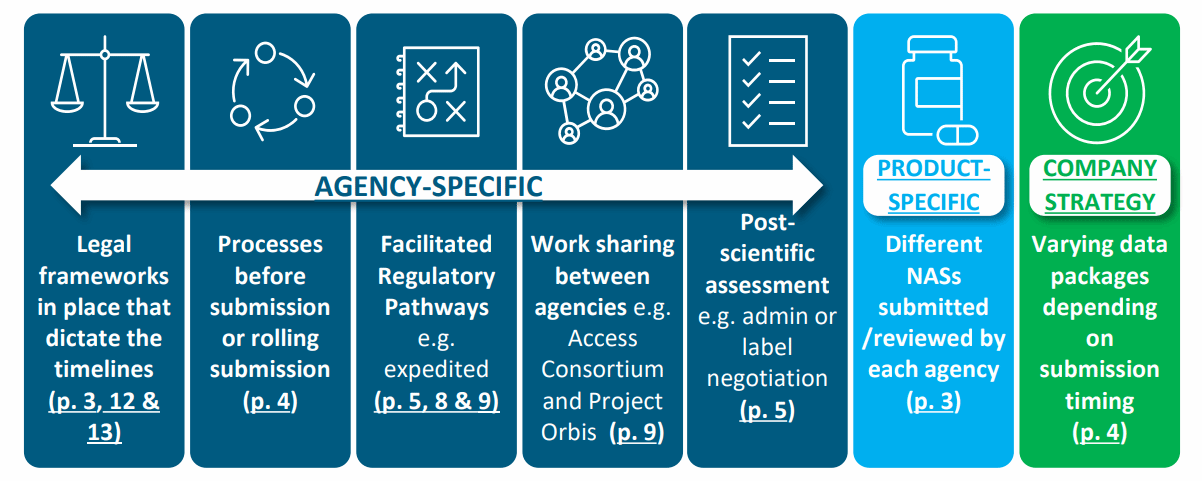
Recently, the Centre for Innovation in Regulatory Science (CIRS) released its annual analysis report focusing on the approval status of New Active Substances (NAS) by six major regulatory agencies—EMA, FDA, Japan's Pharmaceuticals and Medical Devices Agency (PMDA), Health Canada (HC), Swissmedic, and Australia's Therapeutic Goods Administration (TGA)—from 2015 to 2024.
In 2024, FDA approved the highest number of NAS, reaching 56, followed by PMDA (53), Swissmedic (37), EMA (34), TGA (33), and HC (24). Over the past decade, the FDA approved more products than other agencies, but not all drugs can rapidly achieve internationalization. Regarding submission intervals, the median submission interval in 2024 for FDA was the shortest at 0 days, indicating at least half of the NAS were first submitted to FDA, followed by EMA (49 days), TGA (219 days), HC (262 days), Swissmedic (417 days), and PMDA (727 days). Citing the Nature sub-journal article “The rise of China's pharmaceutical industry from 2015–2024: a decade of innovation,” China approved 93 innovative drugs in 2024 (not fully consistent with the NAS definition in this report), of which 42% were domestically developed.

Although all agencies have made progress in the past 20 years, differences still exist in the median approval times of NAS among the six regulatory agencies. In 2024, PMDA had the shortest median approval time of 290 days, followed by FDA (356 days), HC (363 days), TGA (369 days), EMA (430 days), and Swissmedic (444 days). The maximum difference in median approval time between PMDA and Swissmedic reached 154 days. Looking at multi-year data, FDA still approved relatively faster.

The report also shows that the proportion of NAS approvals using accelerated review pathways in 2024 varied by agency. FDA had the highest proportion at 59%, followed by PMDA (34%), HC (29%), Swissmedic (22%), and TGA (9%). EMA did not approve any NAS through accelerated review due to application withdrawals or reverting to standard review. In 2024, the proportions of NAS approved through conditional, provisional, or interim pathways were 18% for both EMA and FDA, 14% for Swissmedic, 12% for TGA, and 8% for HC.

From the top 5 therapeutic areas, between 2020 and 2024, anti-infective therapies had the shortest median approval time among the six regulatory agencies at 284 days, followed by digestive and metabolic therapies (310 days), oncology and immunomodulatory therapies (349 days), blood and hematopoietic organs (362 days), and nervous system (380 days). In the past decade, oncology and immunomodulatory therapies accounted for the highest proportion of NAS approvals by the six regulatory agencies, increasing from 47% in 2015–2019 to 57% in 2020–2024, while the other four areas remained stable or declined.

Although the proportion of NAS approved within the first FDA review cycle dropped to a low of 51% in 2022, it has since shown a steady upward trend, rising to 62% in 2023 and further to 71% in 2024. In 2022, the use frequency of major supplements (roughly equivalent to China's “supplemental review”) was higher than any other year, which helped sponsors correct deficiencies early and avoid receiving Complete Response Letters (CRL). This practice helped the FDA maintain about an 80% approval rate of NAS within the first review cycle. Between 2020 and 2022, NAS without major supplements were approved only after multiple review cycles (in other words, even with multiple supplement opportunities, they failed to ultimately convince the FDA), but this changed in 2023 and 2024, with 8% and 5% respectively approved after multiple review cycles.

In 2024, the data for imported drugs in China show that the first supplement rate for biologics was 95.8%, for innovative chemical drugs and non-2.4 category improved new drugs first submitted was 100%, and the supplement rate for 5.1 category drugs was 62.5%.
Besides the review pathway-related data, the CIRS report also provides a special perspective by examining FDA-approved NAS from the patient experience data (PED) point of view.
In recent years, FDA has increasingly incorporated PED as part of its “patient-focused drug development” (PFDD) program into regulatory decisions. From 2020 to 2024, the proportion of NAS including and/or considering PED steadily increased from 58% to 84%, mainly driven by “sponsors submitting PED and FDA also identifying other sources of PED,” rising from 8% in 2020 to 23% in 2024. The approval proportion based solely on sponsor-submitted PED also increased from 48% in 2020 to 59% in 2024. In contrast, approval cases solely based on FDA independently considering external PED (not submitted by sponsors) fluctuated from 2020 to 2024, accounting for only 2% in 2024. Simply put, PED mainly relies on proactive submission by sponsors.
However, the report points out that due to a lack of public details about how PED is weighed during regulatory review, it is difficult to assess its actual impact on the review process. Therefore, the data are for reference only.

[1]. CIRS RD Briefing 101 – New drug approvals by six major authorities 2015-2024 url:https://cirsci.org/publications/cirs-rd-briefing-101-new-drug-approvals-by-six-major-authorities-2015-2024/
 EN
EN
 Agricultural News
 Food News
 Industrial News
 Cosmetic News
 Pharmaceutical News
 Science News
