-
We detected your language preference as English. Would you like to switch to the English version for a better experience?
Switch to English
Stay here



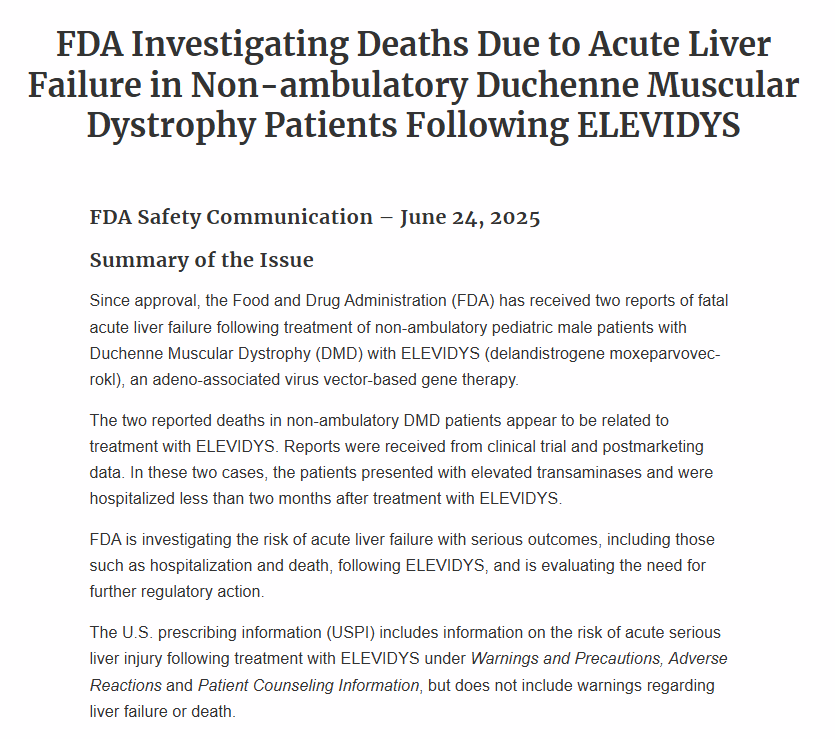
The U.S. Food and Drug Administration (FDA) is reassessing the safety profile of Sarepta Therapeutics’ gene therapy Elevidys for Duchenne muscular dystrophy (DMD) following the deaths of two patients. The agency confirmed Tuesday that it is reviewing whether "further regulatory action" is warranted, though it has not yet disclosed specific measures under consideration.
The FDA's investigation is centered on the possibility of acute liver failure being linked to Elevidys. According to the agency, both patient deaths involved elevated liver enzymes and occurred "less than two months" after treatment. The cases have prompted new concerns regarding the gene therapy’s risk profile.
Sarepta initially disclosed the first patient death in March, citing it as a case of acute liver failure of a severity “not previously reported for Elevidys.” At the time, the company emphasized that liver injury is a known risk associated with gene therapies that use adeno-associated virus (AAV) vectors, the same delivery method Elevidys utilizes. Despite the incident, Sarepta maintained that the therapy’s benefit-risk profile “remains positive.”
A second patient death was reported earlier in June. During a call with investors, Sarepta CEO Doug Ingram reiterated that “liver injury is a known risk of AAV therapies, historically,” and noted that all current clinical-stage gene therapies employ this method. Both patients were non-ambulatory teenagers.
In response, Sarepta initiated additional safety protocols. These include assembling an independent expert panel to evaluate the implementation of an “enhanced immunosuppression regimen” for Elevidys. Additionally, the company has suspended shipments of the therapy for non-ambulatory patients.
The back-to-back deaths have significantly impacted Sarepta's financial standing, with the company’s shares plummeting by approximately 80% since March.

Duchenne muscular dystrophy is a genetic neuromuscular disorder marked by progressive muscle weakening due to mutations in the dystrophin gene. Elevidys attempts to address this by delivering a shortened but functional copy of the gene, thereby targeting the disorder’s root cause.
The FDA had initially granted accelerated approval to Elevidys in June 2023, followed by full approval a year later, permitting use in patients aged four and older. However, the decision-making process has come under scrutiny.
According to reporting by STAT News in June 2024, Peter Marks, then-director of the FDA’s Center for Biologics Evaluation and Research (CBER), overrode staff objections to grant full approval. This decision has been questioned by several industry experts, including Marks’ successor Vinay Prasad. In an August 2024 blog post, Prasad criticized the unilateral move, stating: “Why should a top FDA official unilaterally approve an expensive gene therapy?”
 EN
EN
 Agricultural News
 Food News
 Industrial News
 Cosmetic News
 Pharmaceutical News
 Science News
