-
We detected your language preference as English. Would you like to switch to the English version for a better experience?
Switch to English
Stay here




Lewis structures, devised by Gilbert N. Lewis, visually represent electron arrangements in molecules. By depicting valence electrons as dots and bonds as lines, Lewis structures predict a molecule's shape and properties based on the octet rule. This rule states that atoms tend to achieve stability by having eight electrons in their outer shell. Lewis structures adhere to this rule, offering a clear picture of chemical bonding.
Sodium Bromide (NaBr) is a white, odorless, water-soluble solid composed of sodium (Na) and bromide (Br) ions. It is commonly used in various industrial applications, including photography, as a flame retardant, and in the production of other bromine compounds. Sodium Bromide has the chemical formula NaBr and a molar mass of 102.89 g/mol. It is known for its stability and non-toxic nature.

Let's dive into drawing the nabr lewis structure:
Step 1: Identify the Central Atom: Sodium (Na) is the cation and Bromide (Br) is the anion. Since Na is a metal, it will donate its valence electron to Br.
Step 2: Calculate Total Valence Electrons: Sodium contributes 1 valence electron, and bromine contributes 7 valence electrons, giving a total of 1 + 7 = 8 valence electrons. However, since Na forms an ionic bond with Br, it will donate its electron to Br, leaving Br with 8 electrons (octet).

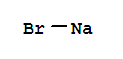
Step 3: Arrange Electrons Around Atoms: Draw a single line (ionic bond) between Na and Br. Place the remaining 7 electrons as lone pairs around Br, ensuring it follows the octet rule.
Step 4: Fulfill the Octet Rule: Ensure that Br has 8 electrons (2 lone pairs and 1 bonding pair), and Na has lost its valence electron, fulfilling the octet rule.
Step 5: Check for Formal Charges: No formal charges are necessary, as both atoms have achieved the octet rule through ionic bonding.
Since Sodium Bromide (NaBr) is an ionic compound, it does not have a molecular geometry in the conventional sense. Instead, it forms a crystal lattice structure. In this structure, Na+ ions are surrounded by Br- ions, and vice versa, creating a stable, repeating pattern.

Ionic compounds like NaBr do not follow the molecular orbital theory, as it applies primarily to covalent molecules. In NaBr, the bonding is predominantly ionic, where the sodium atom donates its valence electron to the bromide ion, forming a stable ionic bond. This process results in a crystal lattice structure rather than a discrete molecule with a specific geometry.
As an ionic compound, NaBr does not exhibit a typical molecular geometry. Instead, it forms a crystal lattice where Na+ ions are surrounded by Br- ions, and vice versa. This structure minimizes electron-electron repulsion and results in a stable configuration.
| Sodium Bromide Cas 7647-15-6 | |
| Molecular formula | NaBr |
| Molecular shape | Ionic crystal lattice |
| Polarity | Ionic (nonpolar in terms of individual bonds) |
To determine if a Lewis structure is polar, examine the molecular geometry and bond polarity. In the case of sodium bromide (NaBr), the Lewis structure shows an ionic bond between sodium (Na+) and bromide (Br-). Since ionic bonds are nonpolar in terms of individual bonds, NaBr is considered nonpolar overall.
To calculate the bond energy of NaBr, look up the lattice energy, which is the energy released when Na+ and Br- ions come together to form the crystal lattice. This value is typically given in kJ/mol. For NaBr, the lattice energy is approximately 747 kJ/mol.
In the Lewis structure of NaBr, the bond order is 1, indicating a single ionic bond between Na+ and Br-. Since ionic bonds involve the complete transfer of an electron, the bond order is always 1.
Electron groups in a Lewis structure include both bonding pairs (shared electrons) and lone pairs (non-bonded electrons) around an atom. In NaBr, there are no lone pairs; instead, there is a single ionic bond between Na+ and Br-, representing the bonding pair.
In a Lewis dot structure, the dots represent valence electrons. Each dot corresponds to one valence electron of an atom. In NaBr, sodium (Na) donates its valence electron to bromine (Br), leaving Br with 8 electrons (octet). The dots help visualize how electrons are shared or paired between atoms.
|
 |
 |
|
|
 |
 EN
EN
 Agricultural News
 Food News
 Industrial News
 Cosmetic News
 Pharmaceutical News
 Science News

 6YRS
6YRS

