-
We detected your language preference as English. Would you like to switch to the English version for a better experience?
Switch to English
Stay here



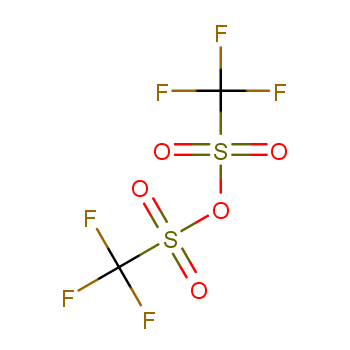
Trifluoromethanesulfonic anhydride (Tf2O, CAS 358-23-6) is a highly reactive fluorinated sulfonylating agent widely used in advanced organic synthesis, pharmaceutical intermediate manufacturing, and superacid chemistry systems. This article provides a bench-to-plant level technical guide covering 19F NMR purity verification, degradation recovery, solvent-dependent stability, controlled quenching protocols, and EHS-compliant handling. It integrates analytical benchmarks, operational safety thresholds, and 2026 supply chain insights to support high-yield and compliant industrial usage.

In modern fluorine chemistry QC workflows, 19F NMR spectroscopy remains the most reliable analytical method for verifying the integrity of Trifluoromethanesulfonic anhydride (Tf2O). The parent compound typically exhibits a sharp resonance centered around -72 to -74 ppm (relative to CFCl3 standard), while hydrolysis or partial decomposition generates triflic acid (TfOH) signals appearing in a distinct downfield-shifted region depending on solvent polarity.
Quantitative integration of the -73 ppm peak against internal standards enables rapid estimation of active reagent content. In high-throughput synthetic laboratories, a purity threshold of ≥98.0% 19F-integrated area is commonly adopted as a minimum acceptance criterion for coupling reactions and activation steps.
Degraded Tf2O, particularly material exposed to trace moisture or prolonged storage, can often be restored to high synthetic grade through controlled drying and fractional distillation. The most widely adopted laboratory-scale purification method involves P2O5-assisted dehydration followed by vacuum distillation.
Standard operational parameters include a boiling range of 81–83°C at atmospheric pressure, though reduced pressure distillation is strongly recommended to minimize thermal decomposition. The system must be rigorously anhydrous, using glassware dried at ≥120°C and assembled under inert gas (argon or nitrogen).
This method is particularly valuable in academic or pilot-scale environments where procurement delays can interrupt synthetic campaigns.

Expert Commentary: The most common failure mode in Tf2O reactivation is incomplete dehydration of distillation assemblies rather than inefficiency of the drying agent itself. Industrial best practice now emphasizes “pre-dry + purge + seal” protocols, where moisture exposure time is reduced below 3 minutes during transfer operations.
Tf2O is highly sensitive to nucleophilic environments, and its stability varies significantly depending on solvent polarity, donor number, and residual moisture content. In chlorinated solvents such as dichloromethane (DCM), Tf2O exhibits relatively stable behavior with half-lives exceeding several hours under anhydrous conditions. However, in coordinating solvents such as DMF or DMSO, rapid decomposition occurs due to nucleophilic attack at the sulfur center.
Recommended storage conditions include -20°C deep-freeze under inert atmosphere or 2–8°C in sealed ampoules for short-term use. Even trace water content (<0.05%) can accelerate hydrolysis kinetics dramatically, producing TfOH and reducing effective electrophilicity.
The quenching of Tf2O is a strongly exothermic process due to rapid hydrolysis to triflic acid. Uncontrolled addition can result in localized overheating, acid mist formation, and pressure spikes in closed systems. Therefore, industry-standard protocols emphasize portion-wise addition under external cooling.
Preferred quenching media include ice-cooled saturated sodium bicarbonate or methanol systems depending on downstream compatibility. Temperature should be strictly maintained below 5°C during initial addition phase.
Expert Commentary: In scale-up environments, quench-related incidents are disproportionately linked to poor heat dissipation rather than reagent quantity. Modern reactor design increasingly incorporates inline calorimetry feedback loops to dynamically adjust Tf2O feed rates and prevent thermal runaway conditions.
According to global chemical safety frameworks, Tf2O is classified as a highly corrosive substance (GHS Category 1A) with severe reactivity toward water and alcohols. Exposure generates triflic acid fumes, which are both corrosive and toxic to respiratory tissues.
Disposal protocols require full neutralization prior to waste segregation. Neutralized residues should be classified as halogenated acidic waste streams under institutional EHS guidelines.
Q1: Why is 19F NMR preferred for Tf2O quality control?
19F NMR provides direct fluorine environment mapping, allowing rapid discrimination between intact Tf2O (-73 ppm) and hydrolyzed TfOH species without derivatization or chromatographic separation.
Q2: Can degraded Tf2O always be recovered?
Not always. Mild hydrolysis can be reversed via drying and distillation, but extensive decomposition leads to irreversible TfOH formation and reduced electrophilic capacity.
[1] PubChem Compound Summary: Trifluoromethanesulfonic anhydride (CID 9833), National Center for Biotechnology Information (NCBI).
[2] ISO 11014:2019 Safety data sheet for chemical products — Content and order of sections.
[3] Journal of Fluorine Chemistry, Elsevier: Organofluorine sulfonylation reagents in modern synthesis (recent review articles, 2022–2025 updates).
[4] CAS Registry Database, American Chemical Society (CAS RN: 358-23-6).
[5] ECHA Chemical Safety Report: Corrosive substances handling guidelines (Category 1A reagents).
Looking for stable, high-purity Trifluoromethanesulfonic anhydride with full regulatory compliance? Discover why leading global pharmaceutical and materials science teams rely on premium-grade fluorinated reagent supply chains.
 |
 |
|
 |
 |
 |
 EN
EN
 Agricultural News
 Food News
 Industrial News
 Cosmetic News
 Pharmaceutical News
 Science News

 5YRS
5YRS


Expert Commentary: In fluorination-heavy API development, relying on visual inspection alone leads to reproducibility failures exceeding 15–25% in activation yield. Experienced process chemists increasingly embed 19F NMR as a “pre-reaction gatekeeper” rather than a confirmatory test. The future of Tf2O QC is moving toward automated flow-NMR integration at receiving warehouses to eliminate latent hydrolysis risk before downstream dispatch.