-
We detected your language preference as English. Would you like to switch to the English version for a better experience?
Switch to English
Stay here



It can be observed that, unlike other leading domestic ADC drug developers who often transitioned to this field based on external circumstances, Hengrui has been deeply involved in this field for more than a decade and has never given up on this route. It wasn't until the development of the third-generation ADC drug was driven by Daiichi Sankyo that Hengrui seemed to find inspiration and fully shifted towards developing new-generation ADC drugs. The company established the HRMAP ADC strategic platform and initiated innovations across multiple dimensions.

According to incomplete statistics, since 2020, Hengrui has launched 12 ADC drugs into clinical trials, with one HER2 ADC drug already submitted for market approval, and five drugs in Phase III clinical trials. It is currently the company with the deepest ADC pipeline in China, with many of its drugs leading in development progress.
In addition, Hengrui has established multiple ADC platforms and engaged in several BD licensing deals. Hengrui's investment in the ADC field has allowed it to distance itself from the characteristics of large pharmaceutical companies, reaching the flexibility of biotech companies in terms of innovation depth and breadth, and it is set to lead the domestic ADC drug market. This article briefly outlines this development.
SHR-A1811, as the first product from Hengrui's innovative ADC platform, is aimed at the next-generation HER2 ADC drug DS-8201 developed by Daiichi Sankyo. SHR-A1811 was first applied for IND in China in May 2020, while DS-8201 was approved for market release in the United States in December 2019, showing a significant gap.
SHR-A1811 consists of trastuzumab, a cleavable tetrapeptide linker GGFG, and a novel topoisomerase I inhibitor payload (SHR9265). The toxin SHR9265 introduces a cyclopropyl group at the amide α position of Dxd. Hengrui also set a differentiated drug-antibody ratio (DAR) value of 5.7, balancing product efficacy and safety, after comparing DAR values of 5.7 and 8.
Clearly, with this product, Hengrui has already moved beyond the simple fast-follow strategy. This requires not only technology but also courage. Due to its rapid development progress, it has even faced the pressure of exceeding DS-8201.

According to the phase I data released during the 2023 AACR, SHR-A1811 showed significant tumor responses in various advanced solid tumors that had previously failed multiple lines of treatment. The overall objective response rate (ORR) in 307 patients with solid tumors was 59.9%.
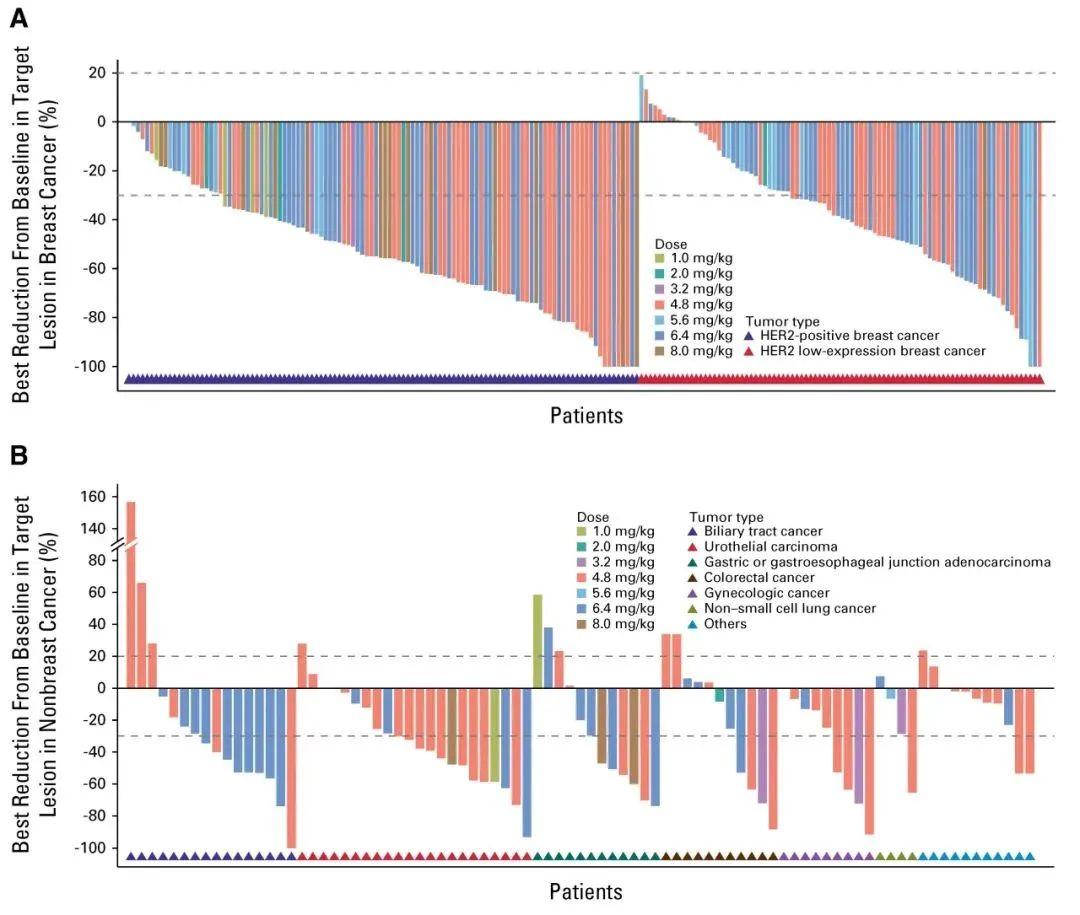
For HER2-positive breast cancer in subsequent treatment, SHR-A1811 achieved an ORR of 81.5%, while DS-8201 showed 62% in the DESTINY-Breast01 study. For HER2-low breast cancer in later-line treatment, SHR-A1811 achieved an ORR of 55.8%, compared to DS-8201's 52.3% in the DESTINY-Breast04 study.
In terms of safety, adverse reactions were at a similar level to DS-8201, but SHR-A1811 had a significantly lower incidence of interstitial pneumonia at 3.2%, compared to DS-8201's 12.1%–15%, showing clear advantages and differentiated platform transformation.
Similarly, the research results on HER2-mutant NSCLC in the 2024 AACR showed that the full-dose group had an ORR of 38.1%, a disease control rate of 90.5%, and a median progression-free survival (PFS) of 9.5 months.
In the 4.8mg/kg dose group (phase II recommended dose, N=43), the investigator-assessed objective response rate was 41.9%, with a disease control rate of 95.3%, and a median PFS of 8.4 months (95% CI: 7.1-15.0). DS-8201 in the DESTINY-Lung01 study had an ORR of 54.9% and a median PFS of 8.2 months, showing similar levels.

Subsequent phase II expansion studies showed that by June 2024, a total of 94 patients had received SHR-A1811 monotherapy. Compared with historical data, SHR-A1811 monotherapy showed significant and clinically meaningful improvements in HER2-mutant NSCLC patients, meeting the pre-specified primary endpoint superiority standards.
In September 2024, Hengrui announced that the SHR-A1811 (RuiKang Trastuzumab) market approval application had been accepted by the NMPA and granted priority review for use in locally advanced or metastatic HER2-mutant adult non-small cell lung cancer patients who had received at least one prior systemic therapy. This is also the first HER2 ADC drug in China to apply for market approval in non-small cell lung cancer.
Currently, SHR-A1811 is undergoing a total of 6 phase III clinical trials in advanced breast cancer, gastric cancer, non-small cell lung cancer, and colorectal cancer, with multiple single-agent and combination therapy clinical studies in progress. Its development is leading, and based on the broad market for HER2 drugs, SHR-A1811 is expected to become one of Hengrui's most important assets in the future.
SHR-A1921 injection is a TROP-2 ADC drug, also composed of a cleavable tetrapeptide linker GGFG and a novel topoisomerase I inhibitor payload (SHR9265), with the same DAR of 4 as Daiichi Sankyo's Dato. The first clinical trial application was submitted in August 2021.
During the 2024 ESMO meeting, Hengrui announced the first human phase I study data of SHR-A1921 in the treatment of platinum-resistant ovarian cancer. As of March 20, 2024, in the 3.0mg/kg dose group, 26 patients were evaluable, with an objective response rate (ORR) of 42.3% and a disease control rate (DCR) of 100.0%. In the 2.0+2.0mg/kg dose group, 17 patients were evaluable, with an ORR of 58.8% and a DCR of 94.1%.

In the ITT population, the median duration of response in the 3.0mg/kg group was 9.9 months, and the median progression-free survival (PFS) was 7.9 months. In the 2.0+2.0mg/kg group, the median duration of response was 6.3 months, and the median PFS was 6.9 months.

Overall, SHR-A1921 monotherapy for recurrent platinum-resistant ovarian cancer showed an ORR of over 40%, with durable responses and a median PFS of around 7 months. The recommended dose showed controllable safety and good tolerance. SHR-A1921 is currently undergoing a phase III clinical trial in platinum-resistant recurrent epithelial ovarian cancer, with the potential to change the treatment landscape of this condition, making it a drug worth looking forward to.
SHR-A1904 injection is a CLND18.2 ADC drug, also composed of a cleavable tetrapeptide linker GGFG and a novel topoisomerase I inhibitor payload (SHR9265), with the first clinical trial application submitted in January 2021.
During the 2024 ESMO meeting, Hengrui announced the first human phase I study data of SHR-A1904 in the treatment of Claudin 18.2-positive gastric cancer/gastroesophageal junction adenocarcinoma. As of March 18, 2024, a total of 73 patients with gastric cancer/gastroesophageal junction adenocarcinoma were enrolled.
In this clinical trial, Hengrui chose the 6.0mg/kg and 8.0mg/kg doses for the efficacy expansion trial. In the 6.0mg/kg dose group, the ORR and DCR were 55.6% and 88.9%, respectively. In the 8.0mg/kg dose group, the ORR and DCR were 36.7% and 86.7%, respectively.

Initial clinical results showed that SHR-A1904 demonstrated controllable safety and good anti-tumor activity in treated Claudin 18.2-positive GC/GEJC patients. SHR-A1904 is currently undergoing a phase III monotherapy clinical trial in second-line Claudin (CLDN) 18.2-positive advanced gastric cancer or gastroesophageal junction adenocarcinoma patients. Its development is in the global forefront, with promising market prospects.
It is worth noting that in October 2023, Hengrui licensed the overseas rights of SHR-A1904 and the oral PARP1 small molecule inhibitor HRS-1167 to Merck for a potential total of €1.4 billion. This marked the first overseas licensing deal for Hengrui's ADC drugs and the initial recognition of its platform.
SHR-A2009 injection is a HER3 ADC drug, also composed of a cleavable tetrapeptide linker GGFG and a novel topoisomerase I inhibitor payload (SHR9265). However, it uses a differentiated DAR design with a DAR value of 4, and the first clinical trial application was submitted in August 2021.
Since SHR-A2009's DAR is only half that of Patritumab Deruxtecan, Daiichi Sankyo announced in the 2021 ASCO that the RP2D dose was 5.6mg/kg. In October 2021, Hengrui initiated its first clinical trial and once advanced the highest dose to the 7th dose group (10.5, 12.0, or 13.5mg/kg).
At the 2024 ESMO meeting, Hengrui presented the preliminary phase I clinical trial results of SHR-A2009 in a cohort of advanced EGFR-mutant NSCLC patients. As of April 30, 2024, 103 EGFR-mutant NSCLC patients were enrolled and treated, with a median follow-up time of 8.6 months. In the expanded 9.0mg/kg dose cohort (n=52), the ORR was 46.9%, and the DCR was 93.9%.

In all treated patients, the median PFS in the 9.0mg/kg cohort was 9.6 months, while the median PFS for all dose cohorts was 6.7 months. Overall, 56.3% of the 103 patients reported ≥ grade 3 treatment-related adverse events (TRAEs), with blood toxicity being the most common, and 8.7% of patients discontinued treatment due to TRAEs, including 8.7% with interstitial lung disease.
Based on these clinical results, in November 2024, Hengrui launched a phase III monotherapy clinical trial of SHR-A2009 in EGFR-mutant advanced or metastatic NSCLC patients who failed platinum-based chemotherapy and EGFR TKI treatment. SHR-A2009 is the first domestic HER3 ADC drug to enter phase III clinical trials.
SHR-A2102 injection is a Nectin-4 ADC drug, also composed of a cleavable tetrapeptide linker GGFG and a novel topoisomerase I inhibitor payload (SHR9265), with a DAR value of 4. The first clinical trial application was submitted in June 2022.
During the 2024 ESMO meeting, Hengrui presented the first human phase I study data of SHR-A2102 in non-small cell lung cancer (NSCLC). In 16 patients with squamous NSCLC, the response rate reached 18.8%, and in 30 patients with non-squamous NSCLC, the response rate reached 36.7%. This is currently the best data for Nectin-4 ADC in NSCLC.

In December 2024, SHR-A2102 initiated a phase III monotherapy clinical trial in locally advanced or metastatic urothelial carcinoma patients who have previously received platinum chemotherapy and PD-(L)1 inhibitors, whether or not they have received ADC treatment. SHR-A2102 is also the first Nectin-4 ADC drug globally to enter phase III clinical trials using a topoisomerase inhibitor toxin.
Based on the excellent early results in non-small cell lung cancer, Hengrui has also initiated an IB/II phase clinical study in combination with a PD-L1 antibody, along with multiple other ongoing clinical trials in various cancers, with an advantage in development progress.
In addition to the topoisomerase I inhibitor payload (SHR9265), Hengrui has also iteratively developed a new toxin, Eribulin, which has been applied to another HER2 ADC and a CD79b ADC drug.
SHR-4602 is a next-generation HER2 ADC drug developed by Hengrui to address resistance to topoisomerase inhibitor toxins. During the 2024 AACR conference, Hengrui presented preclinical data for SHR-4602. SHR-4602 uses pertuzumab as the conjugated antibody, with a cleavable linker and Eribulin toxin (ER300) for construction.

SHR-4602 exhibits good in vitro cytotoxicity, endocytosis activity, and bystander effect. It demonstrated strong anti-tumor efficacy in the JIMT-1 in vivo model, which is resistant to DS-8201 and SHR-A1811. SHR-4602 is designed for second-line treatment in patients who are resistant to DS-8201 and Hengrui's "older generation" HER2 ADC, SHR-A1811. SHR-4602 received clinical trial approval in April 2023 and has rapidly entered a phase II clinical trial in patients with advanced solid tumors expressing or harboring HER2 mutations.
SHR-A1912 is an ADC targeting CD79b, which, according to patents, may also use Eribulin toxin (ER300). It is the only ADC drug in Hengrui's pipeline targeting hematologic cancers and the first CD79b ADC drug to enter clinical trials in China.
At the 2024 ASCO conference, Hengrui presented the first human phase I study results of SHR-A1912 in B-cell non-Hodgkin lymphoma (B-NHL) patients. Among 49 enrolled patients, 41 were evaluable, with an objective response rate (ORR) of 56.1%. Specifically, DLBCL patients had an ORR of 51.9%, and FL and MZL patients showed an ORR of over 60%, at 63.6% and 66.7%, respectively. These results are highly promising. Based on these findings, Hengrui has quickly advanced SHR-A1912 into an IB/II phase clinical trial for B-cell non-Hodgkin lymphoma in combination therapy.

2024 marks a year of rapid development for Hengrui in the ADC field, with multiple early-stage projects presenting initial clinical results and quickly progressing into phase III trials. The company also presented several early-stage ADCs targeting LIV, TF, PSMA, and DLL-3 at the AACR conference, all utilizing the topoisomerase I inhibitor payload (SHR9265) and advancing into clinical stages.
The most noteworthy among these is the DLL-3 ADC drug, SHR-4849. In December 2024, IDEAYA Biosciences secured global development rights outside Greater China for SHR-4849, with a $75 million upfront payment and potential milestone payments totaling up to $2 billion in development and sales.
SHR-4849 uses the topoisomerase I inhibitor payload (SHR9265) with a DAR value of 8, and may innovate with a water-based formulation, greatly enhancing clinical compliance.

SHR-4849 exhibits strong anti-proliferative activity against DLL3 high and intermediate expression tumor cell lines. It also demonstrates a clear bystander effect, where the toxin released by killing DLL3-high expressing cells can also kill DLL3-low expressing cells. No DLL3 ADC has been approved globally as of now. Preclinical models of SHR-4849 have shown promising anti-tumor activity.

SHR-4849 is currently undergoing a phase I clinical trial in China for advanced solid tumors (NCT06443489), in a dose-escalation phase. Clinical responses have been observed in multiple dose groups. As of December 10, 2024, 11 evaluable small cell lung cancer (SCLC) patients have shown a total response rate of around 73%, with 8 patients achieving partial remission. No drug-related adverse events have led to discontinuation, and the safety profile remains controllable.

Hengrui’s self-developed platform has led to the licensing of two ADC drugs, showing external recognition of its technology platform. The company continues to upgrade this platform by developing new toxins such as Eribulin and PBD, while also innovating with tyrosinase-mediated conjugation technology applied to various preclinical projects. Additionally, it is expanding ADC drugs into autoimmune fields, such as IL-4R-targeting drugs.


With over a decade of iterative exploration, Hengrui has demonstrated its powerful technical strength, rich R&D pipeline, excellent clinical performance, and smooth international progress in ADC drug development. Many of its products are in the first development tier. With continuous innovation, Hengrui is expected to achieve significant breakthroughs in the ADC field and may lead global ADC drug development.
More importantly, as a leading pharmaceutical company in China, Hengrui possesses strong commercialization capabilities. The market and commercialization teams it has built over the years provide a solid foundation for the market promotion of ADC drugs. As these ADC drugs are gradually approved and launched, Hengrui’s market share in cancer treatment is expected to grow further.
 |
 |
 |
 EN
EN
 Agricultural News
 Food News
 Industrial News
 Cosmetic News
 Pharmaceutical News
 Science News
