-
We detected your language preference as English. Would you like to switch to the English version for a better experience?
Switch to English
Stay here




Bromine Fluoride (BrF) is a highly reactive and toxic compound that plays a critical role in various industrial processes and research applications. This inorganic compound is composed of a single bromine atom bonded to seven fluorine atoms, forming a linear structure. Bromine Fluoride is known for its intense reactivity, high vapor pressure, and potent oxidizing capabilities. However, before delving into its properties and uses, let's first understand the concept of polarity.
Polarity in chemistry refers to the uneven distribution of electrical charge within a molecule, resulting in regions of positive and negative charge. This uneven charge distribution arises due to differences in electronegativity among the atoms in a molecule. Electronegativity is the ability of an atom to attract electrons towards itself in a chemical bond. When atoms in a molecule have significantly different electronegativities, electrons are pulled closer to the more electronegative atom, creating polar bonds and a polar molecule.
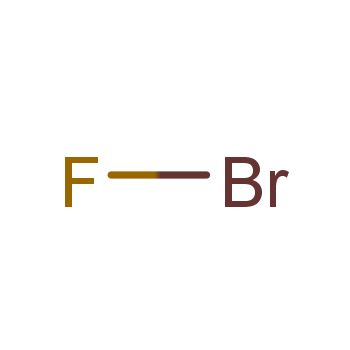
Molecular Geometry Bromine fluoride is a diatomic molecule with a linear geometry. The molecule consists of one bromine atom bonded to one fluorine atom. Since there are only two atoms, the molecular shape is straightforward, leading to an uneven distribution of electron density due to the differences in electronegativity between the two atoms.

Dipole Moment BrF possesses a net dipole moment, which arises from the significant difference in electronegativity between bromine and fluorine. Fluorine, being the most electronegative element, attracts the shared electrons more strongly than bromine, creating a partial negative charge on the fluorine atom and a partial positive charge on the bromine atom. This results in a polar molecule with a distinct dipole moment directed toward the fluorine atom.

Electronegativity: In bromine fluoride, the electronegativity of fluorine (4.0 on the Pauling scale) is considerably higher than that of bromine (2.8). This substantial difference in electronegativity leads to an uneven distribution of electron density within the molecule, further confirming its polarity. Therefore, bromine fluoride is a polar molecule, thanks to its molecular geometry, dipole moment, and the differences in electronegativity between bromine and fluorine.

Bromine Fluoride finds application in various fields due to its unique properties:
Photolithography: Bromine Fluoride is used in the production of photomasks and as a precursor in the development of semiconductor manufacturing processes.
Analytical Chemistry: It is utilized in analytical techniques for the detection and quantification of trace elements in environmental and biological samples.
Materials Science: Bromine Fluoride is involved in the synthesis of new materials and coatings, particularly in the field of optics and electronics.
Research: Due to its reactivity, Bromine Fluoride is a valuable tool in organic synthesis and chemical reactivity studies. Understanding the polarity of Bromine Fluoride provides insights into its behavior in different environments and its potential applications in scientific research and industry.
|
 |
 |
 EN
EN
 Agricultural News
 Food News
 Industrial News
 Cosmetic News
 Pharmaceutical News
 Science News