-
We detected your language preference as English. Would you like to switch to the English version for a better experience?
Switch to English
Stay here




Lewis structures, devised by Gilbert N. Lewis, visually represent electron arrangements in molecules. By depicting valence electrons as dots and bonds as lines, Lewis structures predict a molecule's shape and properties based on the octet rule. This rule states that atoms tend to achieve stability by having eight electrons in their outer shell. Lewis structures adhere to this rule, offering a clear picture of chemical bonding.
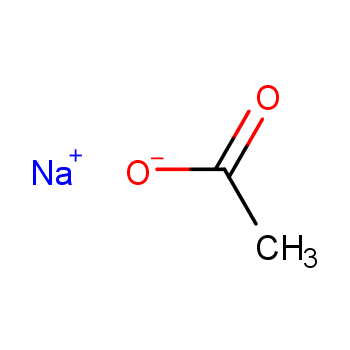
Sodium acetate, with the chemical formula NaC2H3O2 and CAS number 127-09-3, is a white crystalline solid that is soluble in water. It is commonly used in various applications such as food additives, buffering agents, and in the preparation of other acetate compounds. Sodium acetate can be prepared by neutralizing acetic acid with sodium hydroxide or by the reaction of sodium carbonate with acetic acid.
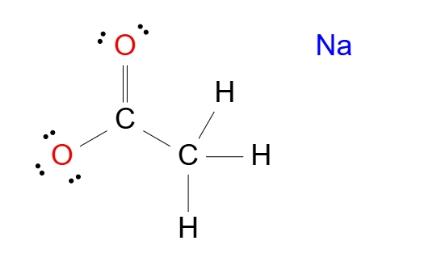
Let's dive into drawing the Lewis structure of sodium acetate (NaC2H3O2):
Step 1: Identify the Central Atom: Carbon (C) is the central atom in the acetate ion (C2H3O2?) because it is less electronegative than oxygen.
Step 2: Calculate Total Valence Electrons: Carbon contributes 4 valence electrons, oxygen contributes 6, and hydrogen contributes 1 each. For the acetate ion (C2H3O2?), we have 4 (C) + 4 (C) +6 (O) + 6 (O) + 1 (H) + 1 (H) + 1 (H) + 1 (extra electron) = 24 valence electrons.
Step 3: Arrange Electrons Around Atoms: Connect the carbon atoms to the oxygen atoms with single bonds (lines). Distribute the remaining electrons as lone pairs around the oxygen atoms and hydrogen atoms.
Step 4: Fulfill the Octet Rule: Ensure each oxygen atom has 8 electrons (2 lone pairs and 2 bonding pairs), and the carbon atom has 8 electrons (2 lone pairs and 2 bonding pairs).
Step 5: Check for Formal Charges: The formal charge should balance out to zero. Ensure the structure is stable and the charges are distributed correctly.
The molecular geometry of sodium acetate involves a central carbon atom bonded to two oxygen atoms and three hydrogen atoms. The acetate ion (C2H3O2?) has a trigonal planar geometry around the carbon atoms, and the sodium ion (Na?) is typically outside the acetate ion, forming an ionic bond.
Molecular orbital theory addresses electron repulsion and the need for compounds to adopt stable forms. In sodium acetate, the acetate ion (C2H3O2?) involves the sharing of electrons between carbon and oxygen atoms. The acetate ion has a delocalized π system, contributing to its stability. The sodium ion (Na?) interacts with the acetate ion through electrostatic forces.
The Lewis structure suggests that the acetate ion (C2H3O2?) adopts a trigonal planar geometry around the carbon atoms. The two oxygen atoms and the three hydrogen atoms are symmetrically positioned around the central carbon atom, minimizing electron-electron repulsion.

The orbitals involved and the bonds produced during the interaction of carbon and oxygen atoms will be examined to determine the hybridization of sodium acetate. The carbon atoms in the acetate ion (C2H3O2?) involve sp2 hybridization, leading to a trigonal planar geometry. The oxygen atoms involve sp3 hybridization.
The bond angle in the acetate ion (C2H3O2?) is approximately 120 degrees, arising from the trigonal planar geometry of the carbon atoms. The bond length between carbon and oxygen is approximately 120 pm, while the bond length between carbon and hydrogen is approximately 110 pm.
| Sodium Acetate Cas 127-09-3 | |
| Molecular formula | NaC2H3O2 |
| Molecular shape | Trigonal planar |
| Polarity | Polar |
| Hybridization | sp2 and sp3 hybridization |
| Bond Angle | 120 degrees |
| Bond length | C-O: 120 pm, C-H: 110 pm |
To determine if a Lewis structure is polar, examine the molecular geometry and bond polarity. In the case of sodium acetate (NaC2H3O2), the acetate ion (C2H3O2?) has a trigonal planar geometry, which is generally nonpolar. However, the presence of the sodium ion (Na?) makes the overall compound polar due to the ionic bond between Na? and C2H3O2?.
To calculate the total bond energy of sodium acetate, first, look up the bond energy for a single carbon-oxygen (C-O) bond, which is approximately 350 kJ/mol. Sodium acetate has multiple C-O bonds, so you multiply the bond energy of one C-O bond by the number of bonds. This gives a total bond energy for the acetate ion (C2H3O2?) and the ionic bond between Na? and C2H3O2?.
Bond order is the number of chemical bonds between a pair of atoms. In the Lewis structure of sodium acetate (NaC2H3O2), each carbon-oxygen bond is a single bond, so the bond order for each C-O bond is 1. If a molecule has resonance structures, bond order is averaged over the different structures, but sodium acetate does not have resonance, so the bond order remains 1.
Electron groups in a Lewis structure include both bonding pairs (shared electrons) and lone pairs (non-bonded electrons) around an atom. In sodium acetate (NaC2H3O2), each carbon atom has three electron groups around it (two bonding pairs and one lone pair), and each oxygen atom has two electron groups (one bonding pair and one lone pair).
In a Lewis dot structure, the dots represent valence electrons. Each dot corresponds to one valence electron of an atom. In sodium acetate (NaC2H3O2), carbon atoms are surrounded by bonding pairs (represented by lines in the Lewis structure) and lone pairs. The dots help visualize how electrons are shared or paired between atoms.
|
 |
 |
 |
 EN
EN
 Agricultural News
 Food News
 Industrial News
 Cosmetic News
 Pharmaceutical News
 Science News

 2YRS
2YRS

