-
We detected your language preference as English. Would you like to switch to the English version for a better experience?
Switch to English
Stay here




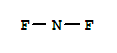
The Lewis structure for Nitrogen Difluoride (NF2) provides a visual representation of the electron arrangement in the molecule. It illustrates how valence electrons are shared between atoms through covalent bonds, adhering to the octet rule. Nitrogen, being less electronegative than fluorine, typically occupies the central position in the NF2 molecule, while each fluorine atom contributes one electron to form a bond with nitrogen, resulting in a total of two bonds. The structure indicates that each fluorine atom has a lone pair of electrons, contributing to the molecule's overall stability.
Nitrogen Difluoride (NF2) is a chemical compound characterized by a nitrogen atom bonded to two fluorine atoms. As a diatomic molecule, it features a linear structure with a bond angle of 180 degrees, due to the sp hybridization of the nitrogen atom. NF2 is known for its role in various industrial applications, including the production of pharmaceuticals, polymers, and in the field of semiconductor processing.

Let’s delve into the process of drawing the Lewis structure for NF2:
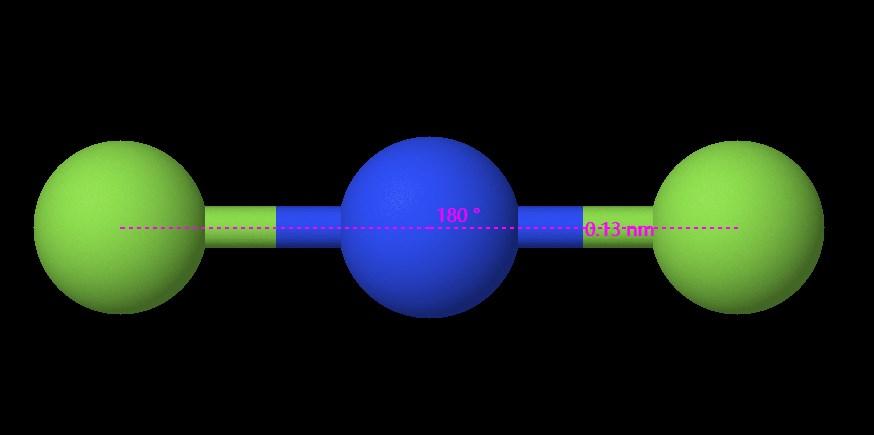
The Lewis structure of NF2 suggests a linear molecular geometry, with a bond angle of 180 degrees. This is due to the sp hybridization of the nitrogen atom, which allows for the formation of a straight line between the nitrogen and the two fluorine atoms.
The molecular orbital theory explains the electronic structure of NF2. The molecule involves the interaction of nitrogen and fluorine atoms, resulting in the formation of two sigma bonds between nitrogen and each fluorine atom. Due to the linear geometry, there are no lone pairs on the nitrogen atom. The molecular orbital diagram would show the filling of atomic orbitals, leading to the formation of the two bonding sigma orbitals and the non-bonding p orbitals on each fluorine atom.
The Lewis structure indicates that NF2 adopts a linear geometry. This arrangement positions the two fluorine atoms directly opposite each other along the axis of the nitrogen atom, forming a straight line. The linear geometry is a result of the sp hybridization of the nitrogen atom, allowing for optimal electron repulsion.
In NF2, the nitrogen atom undergoes sp hybridization. This process combines one s orbital and one p orbital to create two sp hybrid orbitals, which are then used to form the two sigma bonds with the fluorine atoms. The remaining two p orbitals on nitrogen are used to accommodate the lone pairs on the fluorine atoms, ensuring that each fluorine atom achieves a stable octet configuration.
The bond angle in NF2 is approximately 180 degrees, reflecting the linear molecular geometry. The bond length is typically around 130pm, indicating the distance between the nitrogen and fluorine atoms in the molecule.
| Nitrogen Difluoride (NF2) | |
| Molecular Formula | NF2 |
| Molecular Shape | Linear |
| Polarity | Nonpolar |
| Hybridization | sp hybridization |
| Bond Angle | 180 degrees |
| Bond Length | 130pm |
To assess if a Lewis structure is polar, consider the molecular geometry and bond polarity. For NF2, the linear geometry and identical electronegativities of the fluorine atoms result in a cancellation of dipole moments, making the molecule nonpolar.
To find the total bond energy of NF2, refer to the bond energy of a single nitrogen-fluorine bond, typically around 413 kJ/mol. Since NF2 has two such bonds, multiply the bond energy by 2 to obtain the total bond energy, which is approximately 826 kJ/mol.
The bond order in NF2 is determined by the number of bonds between the nitrogen and fluorine atoms. Since each atom is connected by a single bond, the bond order is 1 for each nitrogen-fluorine bond.
In a Lewis structure, electron groups encompass both bonding pairs (shared electrons) and lone pairs (unshared electrons) surrounding an atom. For NF2, each nitrogen atom has two electron groups, consisting of two bonding pairs with the fluorine atoms and no lone pairs.
In the Lewis dot structure for NF2, the dots represent valence electrons. Each dot signifies one valence electron of an atom, illustrating how electrons are distributed and shared between atoms to form covalent bonds.
|
 |
 |
 EN
EN
 Agricultural News
 Food News
 Industrial News
 Cosmetic News
 Pharmaceutical News
 Science News


