-
We detected your language preference as English. Would you like to switch to the English version for a better experience?
Switch to English
Stay here




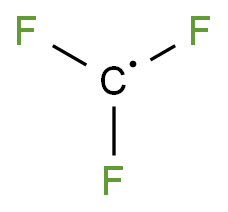
The Lewis structure for Carbon Trifluoride (CF3) visually represents the electron arrangements in the molecule. Carbon, being the central atom, has four valence electrons, while each Fluorine atom has seven valence electrons. The structure adheres to the octet rule, ensuring that all atoms have a full outer shell of electrons, thus stabilizing the compound.
Carbon Trifluoride (CF3) is a compound composed of one carbon atom bonded to three fluorine atoms. It is colorless, highly reactive, and is often used in various industrial applications such as semiconductor manufacturing processes, where it is employed for etching operations due to its strong reactivity with silicon surfaces.

Drawing the Lewis structure for CF3 involves understanding the connectivity and electron distribution within the molecule:

The Lewis structure for CF3 suggests that it adopts a trigonal planar geometry. In this arrangement, the three Fluorine atoms are positioned around the central Carbon atom in a plane, forming three bond pairs. This geometry minimizes electron-electron repulsion and stabilizes the compound.
According to molecular orbital theory, the bonding in CF3 is determined by the interaction of atomic orbitals. The Carbon atom contributes its 2s and 2p orbitals, while the Fluorine atoms contribute their 2p orbitals. The bonding and antibonding orbitals formed through these interactions lead to the stabilization of the trigonal planar structure.
As mentioned earlier, the Lewis structure indicates that CF3 has a trigonal planar geometry. This geometry features the Carbon atom at the center with three Fluorine atoms arranged in a plane, each bonded to the Carbon atom with a single bond.
The hybridization of Carbon in CF3 can be determined by considering the number of regions around the central atom that participate in bonding. With three Fluorine atoms bonded to Carbon, there are three regions of bonding, leading to the formation of three sp2 hybrid orbitals. These hybrid orbitals allow Carbon to form three equivalent single bonds with the Fluorine atoms.
The bond angles in CF3 are approximately 120 degrees, reflecting the trigonal planar geometry of the molecule. The bond length between Carbon and Fluorine atoms is around 102 pm, which is shorter than the typical bond length in other elements due to the high electronegativity of Fluorine.
| Carbon Trifluoride (CF3) | |
| Molecular formula | CF3 |
| Molecular shape | Trigonal planar |
| Polarity | Nonpolar |
| Hybridization | sp2 hybridization |
| Bond angle | 120 degrees |
| Bond length | 102 pm |
To determine if a Lewis structure is polar, consider the molecular geometry and the polarity of the individual bonds. In the case of CF3, the trigonal planar geometry results in symmetrical distribution of the three C-F bonds, leading to a nonpolar molecule despite the polarity of the C-F bonds due to their equal distribution.
Determining bond energy from a Lewis structure typically requires knowledge of the specific bond type and reference data. For CF3, the bond energy of a C-F bond can be estimated using standard values. However, calculating total bond energy would involve summing the energies of all bonds present in the structure.
Bond order is calculated by dividing the number of shared electrons (bonding pairs) by two. For CF3, each C-F bond contributes one shared electron, leading to a bond order of 1 for each bond. This reflects the single bonds present in the structure.
In a Lewis structure, electron groups refer to the regions around an atom that consist of bonding pairs (shared electrons) and lone pairs (unshared electrons). In CF3, each C-F bond represents a bonding pair, and the absence of lone pairs on the Carbon atom indicates that it is participating fully in bonding with the three Fluorine atoms.
 |
|
 EN
EN
 Agricultural News
 Food News
 Industrial News
 Cosmetic News
 Pharmaceutical News
 Science News