-
We detected your language preference as English. Would you like to switch to the English version for a better experience?
Switch to English
Stay here




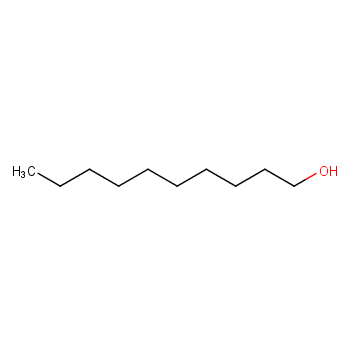
The Lewis structure for 1-decanol depicts the arrangement of electrons in the molecule. It illustrates the valence electrons as dots and bonds as lines, aiding in predicting the molecule's shape and properties. The octet rule is adhered to, indicating that atoms aim for stability by having eight electrons in their outer shell.
1-Decanol, with the CAS number 112-30-1, is an organic compound characterized by a decyl (10-carbon) chain attached to a hydroxyl group (-OH). It is typically used in the manufacturing of detergents and emulsifiers due to its solvating properties.

Let's explore how to construct the Lewis structure for 1-decanol:

The molecular geometry of 1-decanol is determined by the spatial arrangement of atoms around the central carbon atom, influenced by the presence of multiple bonds and lone pairs. This geometry affects the molecule's physical and chemical properties.
Molecular orbital theory explains the bonding and electronic structure of 1-decanol, focusing on the distribution of electrons within the molecule. The theory considers the overlap of atomic orbitals to form molecular orbitals, which are crucial for understanding the molecule's stability and reactivity.
The detailed molecular geometry of 1-decanol can be complex due to the presence of multiple bonds and lone pairs. Understanding this geometry is essential for predicting the molecule's behavior in various chemical reactions and its interactions with other substances.
The hybridization of atoms in 1-decanol influences the molecule's shape, reactivity, and bonding characteristics. The specific hybridization states of carbon and other atoms provide insights into the molecular structure and properties of 1-decanol.
The bond angles and lengths in 1-decanol are critical parameters that define the molecule's geometry. These values contribute to the molecule's overall stability and influence its physical and chemical properties.
| 1-Decanol (112-30-1) | |
| Molecular Formula | C10H22O |
| Molecular Shape | Complex due to multiple bonds and lone pairs |
| Polarity | Moderately polar due to the presence of the hydroxyl group |
| Hybridization | sp3d hybridization (approximate) |
| Bond Angles | Varies depending on the molecule's geometry |
| Bond Lengths | Varies depending on the molecule's geometry |
To assess if a Lewis structure is polar, consider the molecule's geometry and the polarity of individual bonds. A polar molecule will have asymmetric distribution of charge, often due to differences in electronegativity between atoms.
Calculating bond energy involves determining the energy required to break a bond. For a Lewis structure, refer to standard bond energies for the elements involved. Sum these values for all bonds in the molecule to obtain the total bond energy.
Bond order is derived from the number of shared electrons between atoms in a Lewis structure. Each shared electron pair counts as one-half of a bond. Thus, summing the number of shared electron pairs gives the bond order.
Electron groups in a Lewis structure encompass both bonding pairs and lone pairs around an atom. They illustrate the sharing or non-sharing of electrons between atoms, influencing the molecule's structure and chemical behavior.
Dots in a Lewis dot structure represent valence electrons of atoms. They depict the electrons available for bonding, facilitating the visualization of molecular structure and the prediction of chemical properties.
 |
|
 |
 |
|
 EN
EN
 Agricultural News
 Food News
 Industrial News
 Cosmetic News
 Pharmaceutical News
 Science News

 2YRS
2YRS

