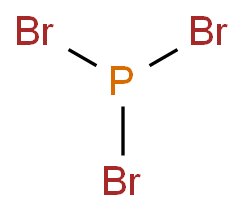
What is the Lewis Structure of Phosphorus tribromide?
Discover the Lewis Structure of Phosphorus tribromide (PBr3) and its molecular geometry. Learn how to draw the structure and understand its bonding, hybridization, polarity, and more.Temple1 MIN READMay 6, 2024
Phosphorus tribromide (PBr3) is an interesting compound in terms of its Lewis structure. Let's delve into how its Lewis structure reveals its bonding and geometry.
What is the Lewis Structures?
Lewis structures, introduced by Gilbert N. Lewis, are diagrams that represent the bonding between atoms in a molecule and the lone pairs of electrons that may exist in the molecule. They are crucial for understanding the geometry and properties of compounds, as they follow the octet rule, which states that atoms tend to combine in such a way that each atom has eight electrons in its valence shell.
What is Phosphorus tribromide?
Phosphorus tribromide (PBr3) is a chemical compound composed of phosphorus and bromine. It is a colorless liquid with a pungent odor, and it reacts violently with water. PBr3 is commonly used as a reagent in organic synthesis, particularly for converting alcohols to alkyl bromides.
How to draw Lewis structures for Phosphorus tribromide (PBr3)?
Let's explore the Lewis structure of PBr3:
Step 1: Identify the Central Atom: Phosphorus (P) is the central atom in PBr3 because it is less electronegative than bromine.
Step 2: Calculate Total Valence Electrons: Phosphorus contributes 5 valence electrons, and each bromine contributes 7, giving a total of 5 + (3 x 7) = 26 valence electrons.
Step 3: Arrange Electrons Around Atoms: Connect each bromine atom to the central phosphorus atom with a single bond (line) and distribute remaining electrons as lone pairs around each bromine atom.
Step 4: Fulfill the Octet Rule: Ensure each bromine atom has 8 electrons (2 lone pairs and 1 bonding pair), and the phosphorus atom has 8 electrons (0 lone pairs and 3 bonding pairs).
Step 5: Check for Formal Charges: Formal charges may not be necessary as all atoms have achieved the octet rule.
Lewis Structure of PBr3
Molecular geometry of Phosphorus tribromide (PBr3)
The Lewis structure suggests that PBr3 adopts a trigonal pyramidal geometry. In this arrangement, the three bromine atoms are positioned around the central phosphorus atom, with one lone pair on phosphorus. This geometry results in a distorted tetrahedral arrangement due to the lone pair's presence, giving rise to a trigonal pyramidal shape.
Pbr3 electron geometry
Hybridization in Phosphorus tribromide
In PBr3, the phosphorus atom undergoes sp3 hybridization. One s orbital and three p orbitals combine to form four sp3 hybrid orbitals. Three of these hybrid orbitals form sigma bonds with the bromine atoms, while the fourth contains the lone pair.
Is Phosphorus tribromide polar or nonpolar?
Phosphorus tribromide (PBr3) is a polar molecule. The lone pair on the central phosphorus atom creates an uneven distribution of electron density, resulting in a net dipole moment. This makes PBr3 polar, with the bromine atoms having a partial negative charge and the phosphorus atom having a partial positive charge.
What are approximate bond angles and Bond length in Phosphorus tribromide?
The approximate bond angle in PBr3 is around 107 degrees. The bond length between phosphorus and bromine atoms is approximately 2.27 angstroms.
Note: Actual bond angles and bond lengths may slightly vary due to factors such as lone pair repulsion and molecular interactions.
Is pbr3 polar or nonpolar?Polarity
Phosphorus TribromideIs PBr3 polar or nonpolar? Phosphorus tribromide, with the molecular formula PBr3, is polar due to the electronegativity difference between phosphorus and bromine. The Lewis structure shows a trigonal pyramidal shape, resulting in a net dipole moment.
What is the Lewis structure for PBr??Lewis Structure
Phosphorus TribromideThe Lewis structure for phosphorus tribromide, PBr3, consists of a phosphorus atom bonded to three bromine atoms through single bonds. This gives it a trigonal pyramidal shape due to a lone pair on phosphorus. Lewis structure for PBr3 effectively represents this molecular arrangement.