Let's delve into the Lewis structure of Malonic acid (C3H4O4), a compound crucial in organic synthesis and the production of pharmaceuticals. Understanding its Lewis structure sheds light on its bonding pattern, molecular geometry, and other essential properties.

What is the Lewis Structures?
Lewis structures, devised by Gilbert N. Lewis, illustrate how valence electrons are arranged among atoms in a molecule. By representing electrons as dots and bonds as lines, Lewis structures provide a framework for understanding chemical bonding. These structures follow the octet rule, where atoms strive to achieve eight electrons in their outermost shell to attain stability.
What is Malonic acid?
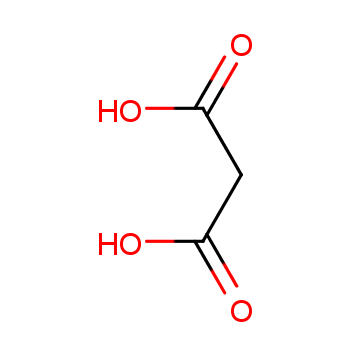
Malonic acid is a dicarboxylic acid with the chemical formula C3H4O4. It is an organic compound found in some fruits and vegetables and is widely used in organic synthesis, particularly in the production of pharmaceuticals, flavors, and fragrances. Its structure consists of two carboxyl groups (-COOH) attached to a central carbon atom.
How to draw Lewis structures for Malonic acid?
Let's explore the steps to draw the Lewis structure of Malonic acid:
Step 1: Identify the Central Atom: In Malonic acid, the central atom is carbon (C), as it forms the backbone of the molecule and can make multiple bonds.
Step 2: Calculate Total Valence Electrons: Carbon contributes 4 valence electrons, and each oxygen contributes 6, giving a total of 4 + (2 x 6) = 16 valence electrons.
Step 3: Arrange Electrons Around Atoms: Form double bonds between one oxygen atom and the central carbon atom, and single bonds between the other oxygen atom and the central carbon atom. Distribute remaining electrons as lone pairs around each oxygen atom.
Step 4: Fulfill the Octet Rule: Ensure each oxygen atom has 8 electrons (2 lone pairs and 2 bonding pairs), and the carbon atom has 8 electrons (1 lone pair and 3 bonding pairs).
Step 5: Check for Formal Charges: Formal charges may not be necessary as all atoms have achieved the octet rule.

(Image Source: Wikipedia)
Molecular geometry of Malonic acid
The Lewis structure suggests that Malonic acid adopts a planar geometry. The carboxyl groups attached to the central carbon atom force the molecule into a flat shape. This planar configuration allows for efficient packing in solid-state structures and influences its reactivity in chemical reactions.

(Image Source: Wikipedia)
Hybridization in Malonic acid
In Malonic acid, the carbon atom undergoes sp2 hybridization. One s orbital and two p orbitals combine to form three sp2 hybrid orbitals. These orbitals then overlap with the p orbitals of oxygen atoms, forming strong σ bonds. This hybridization ensures the stability and structure of the Malonic acid molecule.
Is Malonic acid polar or nonpolar?
Malonic acid is a polar molecule. The electronegativity difference between carbon and oxygen atoms leads to polar covalent bonds. Additionally, the arrangement of the carboxyl groups results in an overall dipole moment, making the molecule polar.
What are approximate bond angles and Bond length in Malonic acid?
The bond angles in Malonic acid are approximately 120 degrees. This angle arises from the planar geometry of the molecule, where the carboxyl groups are arranged symmetrically around the central carbon atom. The bond length between carbon and oxygen atoms is approximately 143 picometers (pm).
Note: Actual bond angles and lengths may vary slightly due to factors like steric hindrance and resonance effects.
Highlight of Malonic acid
| Malonic acid Cas 141-82-2 |
| Molecular formula |
C3H4O4 |
| Molecular shape |
- |
| Polarity |
polar |
| Hybridization |
sp2 hybridization |
| Bond Angle |
120 degrees |
| Bond length |
143 pm |





 EN
EN
 Agricultural News
 Food News
 Industrial News
 Cosmetic News
 Pharmaceutical News
 Science News

 2YRS
2YRS

