Isopropyl alcohol, also known as rubbing alcohol, has an interesting Lewis structure worth exploring. Understanding its Lewis structure provides insights into its chemical bonding and overall molecular properties.

What is the Lewis Structures?
Lewis structures are diagrams that represent the bonding between atoms in a molecule and the lone pairs of electrons that may exist in the molecule. These structures are based on the octet rule, which states that atoms tend to gain, lose, or share electrons to achieve a stable electron configuration with eight electrons in their outermost shell.
What is Isopropyl alcohol?
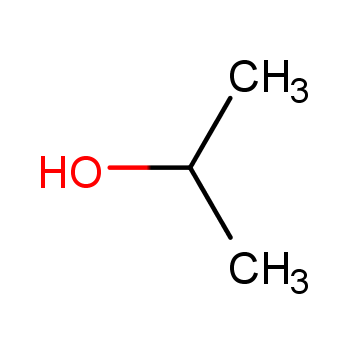
Isopropyl alcohol (C3H8O) is a colorless, flammable chemical compound with a strong odor. It is commonly used as a solvent, disinfectant, and antiseptic. Its molecular structure consists of three carbon atoms, eight hydrogen atoms, and one oxygen atom.
How to draw Lewis structures for Isopropyl alcohol?
Let's outline the steps to draw the Lewis structure of isopropyl alcohol:
Step 1: Identify the Central Atom: In isopropyl alcohol, the central atom is the carbon atom bonded to the oxygen atom because carbon is less electronegative than oxygen.
Step 2: Calculate Total Valence Electrons: Carbon contributes 4 valence electrons, each hydrogen contributes 1, and oxygen contributes 6, giving a total of 4 + (8 x 1) + 6 = 18 valence electrons.
Step 3: Arrange Electrons Around Atoms: Connect each hydrogen atom to the central carbon atom with a single bond (line) and the oxygen atom with a single bond. Distribute remaining electrons as lone pairs around the oxygen atom.
Step 4: Fulfill the Octet Rule: Ensure each atom has an octet of electrons, except hydrogen, which follows the duet rule. The carbon atom should have 8 electrons (4 bonding pairs), the oxygen atom should have 8 electrons (2 lone pairs and 2 bonding pairs), and each hydrogen atom should have 2 electrons (1 bonding pair).
Step 5: Check for Formal Charges: Formal charges may not be necessary as all atoms have achieved stable electron configurations.

Molecular geometry of Isopropyl alcohol
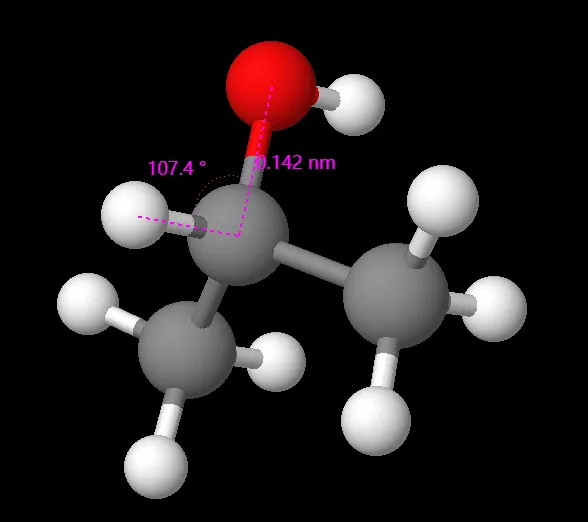
The molecular geometry of isopropyl alcohol is approximately trigonal planar around the central carbon atom. The carbon atom is bonded to three atoms (two hydrogen atoms and one oxygen atom) and has no lone pairs, resulting in a planar arrangement.
Hybridization in Isopropyl alcohol
In isopropyl alcohol, the carbon atom undergoes sp3 hybridization. One s orbital and three p orbitals combine to form four sp3 hybrid orbitals. These orbitals then overlap with the orbitals of the hydrogen and oxygen atoms, forming four strong σ bonds.
Is Isopropyl alcohol polar or nonpolar?
Isopropyl alcohol is polar due to the electronegativity difference between carbon and oxygen. The oxygen atom is more electronegative than carbon, causing a partial negative charge on the oxygen atom and a partial positive charge on the carbon atom. This polarity gives isopropyl alcohol its characteristic properties, such as solubility in water.
What are approximate bond angles and Bond length in Isopropyl alcohol?
The bond angle in isopropyl alcohol is approximately 109.5 degrees. The bond length of the carbon-oxygen bond is approximately 143 picometers (pm), and the bond length of the carbon-hydrogen bond is approximately 109 pm.
Note: These values may vary slightly due to factors like bond strain and molecular interactions.
Highlight of Isopropyl alcohol
| Isopropyl alcohol Cas 67-63-0 |
| Molecular formula |
C3H8O |
| Molecular shape |
- |
| Polarity |
polar |
| Hybridization |
sp3 hybridization |
| Bond Angle |
109.5 degrees |
| Bond length |
143 pm |




 EN
EN
 Agricultural News
 Food News
 Industrial News
 Cosmetic News
 Pharmaceutical News
 Science News

 1YR
1YR

