Discover the Lewis structure of Diethyl ether (C4H10O) and its molecular insights. Learn how to draw its Lewis structure, molecular geometry, hybridization, polarity, bond angles, and more.Sally1 MIN READMay 7, 2024
Welcome to the world of molecular structures! Let's delve into the Lewis structure of Diethyl ether (C4H10O), a fascinating compound with various uses and properties. Understanding its Lewis structure provides insights into its bonding and molecular characteristics.
What is the Lewis Structures?
Lewis structures, formulated by Gilbert N. Lewis, are diagrams representing the arrangement of valence electrons in molecules. By indicating valence electrons as dots and bonds as lines, Lewis structures help predict a molecule's shape and behavior based on the octet rule, where atoms tend to have eight electrons in their outer shell to achieve stability.
What is Diethyl ether?
Diethyl ether, also known as ethyl ether or simply ether, is a colorless, highly volatile, and flammable liquid with the chemical formula C4H10O. It is commonly used as a solvent, anesthetic, and as a starting material in the synthesis of various organic compounds.
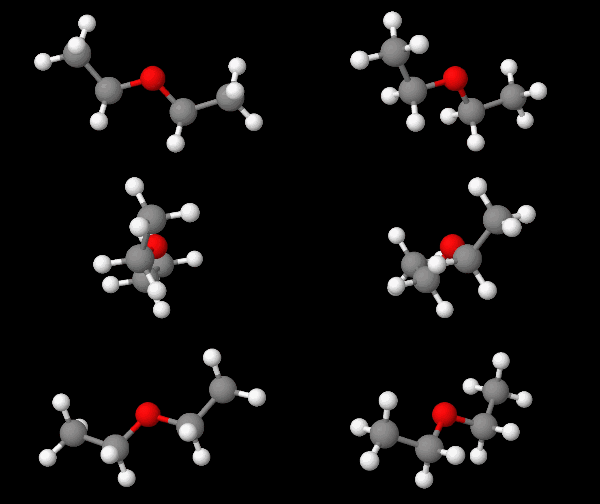
Molecular geometry of C4H10O (Diethyl ether)
How to draw Lewis structures for Diethyl ether?
Let's explore drawing the Lewis structure of Diethyl ether:
Step 1: Identify the Central Atom: In Diethyl ether, oxygen (O) is the central atom as it's more electronegative than carbon.
Step 2: Calculate Total Valence Electrons: Oxygen contributes 6 valence electrons, and each carbon contributes 4, giving a total of 6 + (4 x 4) + 10 = 32 valence electrons.
Step 3: Arrange Electrons Around Atoms: Connect each carbon atom to the central oxygen atom with single bonds (lines) and distribute remaining electrons as lone pairs around the oxygen atom.
Step 4: Fulfill the Octet Rule: Ensure each carbon atom has 8 electrons (2 lone pairs and 2 bonding pairs), and the oxygen atom has 8 electrons (2 lone pairs and 2 bonding pairs).
Step 5: Check for Formal Charges: Formal charges may not be necessary as all atoms have satisfied the octet rule.
Diethyl ether lewis structure
Molecular geometry of Diethyl ether
The Lewis structure suggests that Diethyl ether adopts a bent or V-shaped geometry. The oxygen atom lies at the center, with two carbon atoms bonded to it, each forming a single bond. This arrangement gives rise to a bent shape with approximate bond angles around 109.5 degrees.
Hybridization in Diethyl ether
In Diethyl ether, the oxygen atom undergoes sp3 hybridization. One s orbital and three p orbitals of oxygen hybridize to form four sp3 hybrid orbitals. These orbitals then overlap with the sp3 hybridized orbitals of carbon atoms to form four strong σ bonds. This hybridization ensures the stability and geometry of the Diethyl ether molecule.
Is Diethyl ether polar or nonpolar?
Diethyl ether is a polar molecule. Although the individual C-O bonds are polar due to the electronegativity difference between carbon and oxygen, the overall molecule is polar because of its bent shape. This shape results in an uneven distribution of charge, with the oxygen atom being more electronegative and pulling electron density towards itself.
What are approximate bond angles and Bond length in Diethyl ether?
The approximate bond angle in Diethyl ether is around 109.5 degrees. This angle arises from the bent geometry around the oxygen atom. The bond length of the C-O bond in Diethyl ether is approximately 141 picometers (pm).
Note: Actual bond angles and lengths may vary slightly due to factors such as steric effects and bond resonance.
What is the lewis dot structure for ch3ch2och2ch3?Lewis Structure
Diethyl EtherThe Lewis structure for diethyl ether, C2H5OC2H5, features an ether linkage where an oxygen atom is single-bonded to two ethyl groups (C2H5). This structure indicates a bent shape around the oxygen atom. The lewis dot structure for CH3CH2OCH2CH3 clearly illustrates this arrangement.
Is ether polar or nonpolar?Polarity
DIETHYL ETHERIs ether polar or nonpolar? Diethyl ether (C?H??O) is a polar molecule due to the presence of an oxygen atom between two ethyl groups (C?H?). This arrangement creates a dipole moment, with partial positive and negative charges, resulting in polarity.
Is (CH3CH2)2O polar or nonpolar?Polarity
Diethyl etherIs (CH3CH2)2O polar or nonpolar? The C-O bond is slightly polar, but the symmetrical shape of the molecule makes it nonpolar overall as the molecular dipoles cancel out.







 EN
EN
 Agricultural News
 Food News
 Industrial News
 Cosmetic News
 Pharmaceutical News
 Science News
