
Welcome to the intriguing world of molecular structures! Today, let's delve into the fascinating compound Cyanato (CNO) and explore its Lewis structure, molecular geometry, hybridization, polarity, approximate bond angles, and bond length. Understanding these aspects sheds light on Cyanato's behavior and properties in various chemical contexts.
What is the Lewis Structures?
Lewis structures, pioneered by Gilbert N. Lewis, are diagrams that represent the bonding between atoms in a molecule and the lone pairs of electrons present. By depicting valence electrons as dots and bonds as lines, Lewis structures provide a visual understanding of chemical bonding and molecular structure, crucial for predicting a molecule's behavior and properties.
What is Cyanato (CNO)?
Cyanato (CNO) is a chemical compound consisting of one carbon (C), one nitrogen (N), and one oxygen (O) atom. It is commonly encountered as the cyanate ion, -OCN, in various inorganic and organic compounds. Cyanato exhibits interesting chemical properties and is of significance in fields ranging from industrial chemistry to biochemistry.
How to draw Lewis structures for Cyanato (CNO)?
Let's explore the process of drawing the Lewis structure of Cyanato (CNO):
Step 1: Identify the Central Atom: In Cyanato (CNO), carbon (C) is the central atom since it is typically the least electronegative.
Step 2: Calculate Total Valence Electrons: Carbon contributes 4 valence electrons, nitrogen contributes 5, and oxygen contributes 6, giving a total of 4 + 5 + 6 = 15 valence electrons.
Step 3: Arrange Electrons Around Atoms: Form single bonds (lines) between carbon, nitrogen, and oxygen atoms, distributing remaining electrons as lone pairs to fulfill the octet rule for each atom.
Step 4: Fulfill the Octet Rule: Ensure that carbon, nitrogen, and oxygen atoms each have eight electrons around them, either as lone pairs or bonding pairs.
Step 5: Check for Formal Charges: Verify that formal charges are minimized to achieve the most stable Lewis structure.

Molecular geometry of Cyanato (ocn lewis structure)
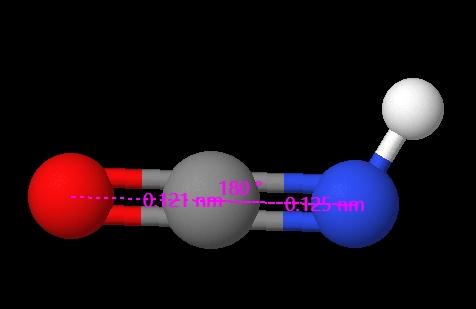
The Lewis structure of Cyanato (CNO) suggests a linear geometry, with carbon at the center bonded to nitrogen and oxygen atoms on either side. This arrangement minimizes electron repulsion, resulting in a stable molecular configuration.
Hybridization in Cyanato (CNO)
In Cyanato (CNO), the carbon atom undergoes sp hybridization. One s orbital and one p orbital combine to form two sp hybrid orbitals. These orbitals then overlap with the orbitals of nitrogen and oxygen atoms, forming two strong σ bonds. This hybridization ensures the stability and structural integrity of the Cyanato (CNO) molecule.
Cyanato (CNO) is a polar molecule. Although the bonds between carbon, nitrogen, and oxygen atoms may have different electronegativities, the linear geometry of the molecule results in an overall dipole moment, making it polar.
What are approximate bond angles and Bond length in Cyanato (CNO)?
The bond angles in Cyanato (CNO) are approximately 180 degrees due to its linear geometry. The bond length between carbon and nitrogen, as well as carbon and oxygen, is typically in the range of 120-140 pm, depending on the specific compound and its molecular environment.
Note: Actual bond angles and lengths may vary slightly due to factors such as lone pair repulsion and bond polarity.
Highlight of Cyanato (CNO)
| Cyanato Cas 22400-26-6 |
| Molecular formula |
CNO |
| Molecular shape |
Linear |
| Polarity |
Polar |
| Hybridization |
sp hybridization |
| Bond Angle |
180 degrees |
| Bond length |
Approximately 120-140 pm |




 EN
EN
 Agricultural News
 Food News
 Industrial News
 Cosmetic News
 Pharmaceutical News
 Science News

