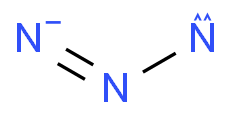
Welcome to the intriguing world of molecular structures! Today, we'll explore the Lewis structure of azide (N3-), a fascinating compound with important applications in chemistry and industry. Understanding the Lewis structure of azide is crucial for comprehending its bonding pattern, geometry, and properties.

What is the Lewis Structures?
Lewis structures, devised by Gilbert N. Lewis, provide a visual representation of electron distribution in molecules. They depict valence electrons as dots and bonds as lines between atoms, following the octet rule. This rule dictates that atoms tend to gain, lose, or share electrons to achieve a stable electron configuration resembling that of noble gases. Lewis structures serve as a fundamental tool for predicting molecular properties and behavior.
What is Azide?
Azide (N3-) is a polyatomic anion composed of three nitrogen atoms bonded linearly. It carries a negative charge, making it an important functional group in various chemical compounds. Azides are widely used in organic synthesis, pharmaceuticals, and explosives due to their unique reactivity.
How to draw Lewis structures for Azide?
Let's delve into drawing the Lewis structure of azide (N3-):
Step 1: Count Total Valence Electrons: Each nitrogen atom contributes 5 valence electrons, and since there are three nitrogen atoms, the total is 5 x 3 = 15 electrons. Add one additional electron for the negative charge, giving a total of 16 valence electrons.
Step 2: Arrange Electrons Around Atoms: Connect the three nitrogen atoms with double bonds, each nitrogen atom sharing one electron with the adjacent nitrogen atom. Distribute the remaining electrons as lone pairs on the terminal nitrogen atoms.
Step 3: Fulfill the Octet Rule: Ensure each nitrogen atom (except the central one) has 8 electrons around it, either through bonding or lone pairs. The central nitrogen atom will have a complete octet with only six electrons.
Step 4: Check for Formal Charges: All nitrogen atoms have zero formal charges in the Lewis structure of azide.

Molecular geometry of Azide
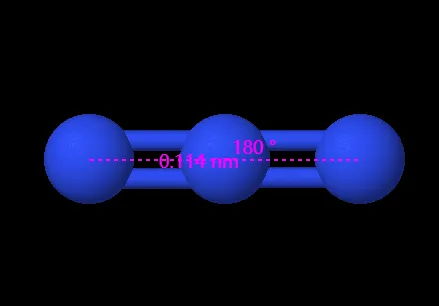
The Lewis structure suggests that azide adopts a linear geometry. The three nitrogen atoms are symmetrically positioned in a straight line, forming two nitrogen-nitrogen double bonds. This linear arrangement minimizes electron-electron repulsion, resulting in a stable configuration.
Hybridization in Azide
In azide, each nitrogen atom undergoes sp hybridization. One s orbital and one p orbital combine to form two sp hybrid orbitals, which participate in the double bonds. This hybridization ensures the stability of the azide molecule.
Is Azide polar or nonpolar?
Azide (N3-) is a polar molecule. Although the individual nitrogen-nitrogen bonds are nonpolar due to their identical electronegativities, the asymmetric arrangement of the nitrogen atoms results in an overall dipole moment. The lone pairs on the terminal nitrogen atoms contribute to this polarity.
What are approximate bond angles and Bond length in Azide?
In azide, the bond angle between the nitrogen atoms is approximately 180 degrees, as it adopts a linear geometry. The bond length of the nitrogen-nitrogen double bonds is approximately 116 pm.
Note: While these values are theoretical and based on idealized geometries, real molecules may exhibit slight deviations due to factors such as lone pair repulsion and bond polarity.
Highlight of Azide
| Azide Cas 14343-69-2 |
| Molecular formula |
N3- |
| Molecular shape |
Linear |
| Polarity |
polar |
| Hybridization |
sp hybridization |
| Bond Angle |
180 degrees |
| Bond length |
116 pm |





 EN
EN
 Agricultural News
 Food News
 Industrial News
 Cosmetic News
 Pharmaceutical News
 Science News