-
We detected your language preference as English. Would you like to switch to the English version for a better experience?
Switch to English
Stay here




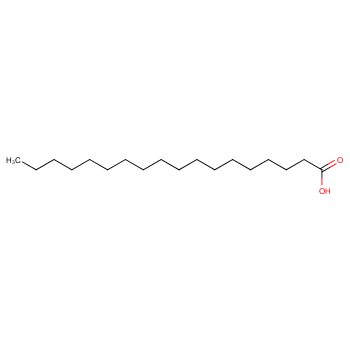
Stearic acid (C??H??O?) is a long-chain fatty acid commonly found in various animal and plant fats. As an amphipathic molecule, it has two distinct parts with different chemical properties: a polar carboxyl group (-COOH) at one end and a long nonpolar hydrocarbon chain consisting of 18 carbon atoms. This structure gives stearic acid its unique characteristics, making it an essential component in the formation of soaps, cosmetics, and many personal care products. The amphipathic nature of stearic acid allows it to interact with both polar and nonpolar substances, leading to its widespread use in applications where emulsification or surface conditioning is required. But what exactly does it mean for a molecule to be amphipathic, and how does this influence its behavior in chemical processes?
Amphipathicity describes a molecule’s combination of both hydrophilic (water-attracting) and hydrophobic (water-repelling) regions. This unique property enables amphipathic molecules to interact with polar and nonpolar environments, which is especially relevant in biological and chemical systems where substances must mix or remain stable across different types of media.
Is Stearic Acid polar or nonpolar? In the case of amphipathic molecules like stearic acid, the polar carboxyl group (-COOH) readily interacts with water due to its polar nature, while the nonpolar hydrocarbon tail repels water but can dissolve in lipids and oils. This combination enables stearic acid to function as a surfactant, reducing surface tension between different phases, such as oil and water. The amphipathic nature of stearic acid is critical in applications ranging from skincare products to food additives. But how does the structure of stearic acid support this amphipathicity?
Is Stearic Acid polar or nonpolar? To understand the amphipathic nature of stearic acid (C??H??O?), let’s examine its structure in terms of molecular geometry, dipole moment, and electronegativity.
Molecular Structure: Stearic acid consists of an 18-carbon chain attached to a carboxyl (-COOH) group at one end. The carboxyl group, which contains two oxygen atoms, is highly polar, while the rest of the molecule, the hydrocarbon tail, is entirely nonpolar. This stark contrast between the polar and nonpolar parts of the molecule enables stearic acid to be classified as amphipathic.

Dipole Moment: In stearic acid, the dipole moment is concentrated at the polar carboxyl end due to the high electronegativity of the oxygen atoms relative to the hydrogen and carbon atoms in the molecule. This separation of charges within the molecule creates a dipole moment at one end, while the hydrocarbon tail remains nonpolar.
Electronegativity: The oxygen atoms in the carboxyl group have a higher electronegativity (3.44) than both the carbon (2.55) and hydrogen (2.20) atoms in the hydrocarbon chain. This disparity in electronegativity leads to an uneven electron distribution within the molecule, further reinforcing the polarity of the carboxyl group and the nonpolarity of the hydrocarbon tail.
| Element Electronegativity | |
| O | 3.44 |
| H | 2.20 |
| C | 2.55 |

The substantial electronegativity difference between the oxygen atoms and the hydrocarbon tail's carbon and hydrogen atoms creates a molecular region with partial charges, classifying stearic acid as an amphipathic molecule.
Thus, stearic acid (C??H??O?) exhibits both polar and nonpolar characteristics. Its molecular structure, combined with electronegativity differences, supports its function in products that require emulsification or surface conditioning, as well as in biological processes where amphipathicity is essential.
| Stearic Acid Cas 57-11-4 | |
| Molecular formula | C18H36O2 |
| Molecular shape | Linear |
| Relative molecular mass | 284.48 g/mol |
| Melting point | 69.3 °C (156.7 °F) |
| Boiling point | 361.0 °C (681.8 °F) |
| Compound | Polarity | Applications |
| Palmitic Acid (C??H??O?) | amphipathic | Used in cosmetics, soaps, and as a component in food products and biodiesel. |
| Lauric Acid (C??H??O?) | Nonpolar overall with a slight polarity from the carboxyl group; shorter chain than stearic acid. | Used in soaps, detergents, and as an antimicrobial agent in personal care products. |
After exploring the polarity chemistry of C??H??O?, have you gained a deeper understanding of whether it is "polar or nonpolar"? While C??H??O? as a molecule is amphipathic, this does not necessarily mean that all of its bonds are amphipathic bonds. If you're interested in similar compounds or related supply chain resources, Guidechem offers a comprehensive list of global Stearic Acid?suppliers, where you can find the right procurement plan to meet your research and production needs.
 |
|
 |
 |
 |
 EN
EN
 Agricultural News
 Food News
 Industrial News
 Cosmetic News
 Pharmaceutical News
 Science News

 1YR
1YR

