-
We detected your language preference as English. Would you like to switch to the English version for a better experience?
Switch to English
Stay here




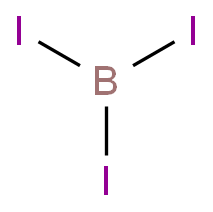
Boron triiodide (BI?) is an inorganic compound consisting of one boron atom bonded to three iodine atoms. This molecule is notable for its unique properties and its role in various chemical reactions. Despite the apparent polarity from the difference in electronegativity between boron and iodine, the molecular symmetry of BI? plays a key role in determining its overall polarity. Due to its trigonal planar geometry, the dipoles of the individual B-I bonds cancel out, resulting in a nonpolar molecule. But how does the symmetry of BI? influence its polarity, and why does the electronegativity difference not lead to an overall dipole moment?
Polarity refers to the uneven distribution of charge within a molecule, typically resulting from differences in electronegativity between bonded atoms. When atoms with differing electronegativities form a bond, the shared electrons are attracted more strongly to the more electronegative atom, leading to partial positive and negative charges on different parts of the molecule.
Is bi3 polar or nonpolar? A molecule is polar if the electron distribution does not cancel out, creating a net dipole moment. Conversely, if the distribution is symmetric, the individual dipoles cancel out, and the molecule remains nonpolar. This is the case for molecules like BI?, where the geometry of the molecule results in an equal distribution of charge despite the electronegativity differences between boron and iodine.
Is bi3 polar or nonpolar? To determine whether Boron triiodide (BI?) is polar or nonpolar, we can examine it from three main perspectives: molecular geometry, dipole moment, and electronegativity.
Molecular Geometry: Boron triiodide has a trigonal planar shape due to the three bonds between boron and iodine atoms. This symmetrical arrangement means that any dipoles created by the B-I bonds are balanced out, resulting in no net dipole moment.

Dipole Moment: A molecule's dipole moment measures the separation of charges within the molecule. Despite the electronegativity difference between boron (2.04) and iodine (2.66), the symmetrical distribution of the bonds ensures that the individual dipoles cancel out, leaving BI? without a net dipole moment.
Electronegativity: The electronegativity difference between boron and iodine is relatively small (0.62), which leads to only a minor polar character within each B-I bond. However, the symmetry of the molecule ensures these small polarities do not affect the overall charge distribution.

Since Boron triiodide is nonpolar, it behaves differently from polar molecules in chemical reactions and interactions.
| Boron Triiodide (BI3) | |
| Molecular formula | BI3 |
| Molecular shape | Trigonal planar |
| Relative molecular mass | 391.53g/mol |
| Solubility | insoluble in water |
| Melting point | 44 °C |
| Boiling point | 210 °C |
| Compound | Polarity | Applications |
| Boron Trifluoride (BF?) | Nonpolar due to symmetric trigonal planar structure. | Used as a Lewis acid in catalysis and chemical synthesis. |
After exploring the polarity chemistry of BiI?, have you gained a deeper understanding of whether it is "polar or nonpolar"? While BiI? as a molecule is polar , this does not necessarily mean that all of its bonds are polar bonds. If you're interested in similar compounds or related supply chain resources, Guidechem offers a comprehensive list of global Boron triiodide?suppliers, where you can find the right procurement plan to meet your research and production needs.
|
 |
 |
 |
 EN
EN
 Agricultural News
 Food News
 Industrial News
 Cosmetic News
 Pharmaceutical News
 Science News

 6YRS
6YRS

