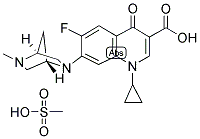
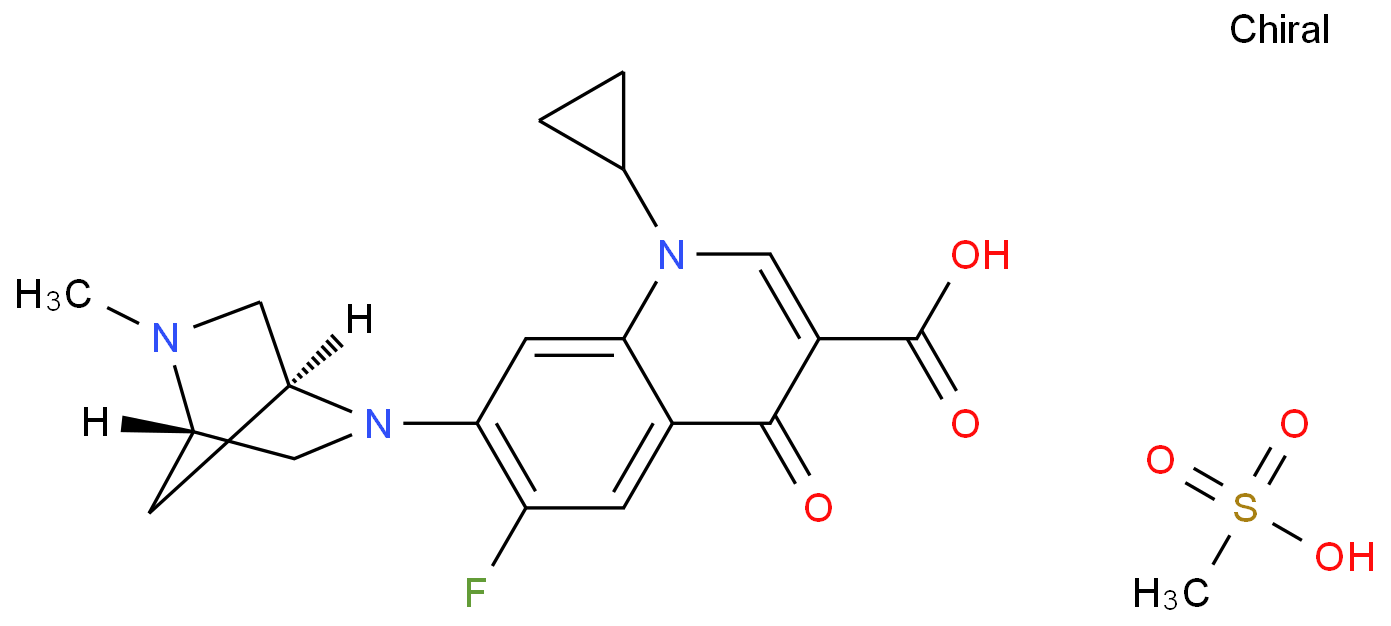
The determination of drug content is an important experimental task in the fields of pharmacy and chemistry, crucial for ensuring the quality and safety of pharmaceuticals. Danofloxacin mesylate, as a commonly used antibiotic, its accurate determination is of significant importance for drug production, quality control, and clinical applications.
Introduction:
Danofloxacin mesylate is another fluoroquinolone drug developed after enrofloxacin, specifically for animals. It is a chiral fluoroquinolone drug with high research and development value. This product was first introduced by Pfizer Inc., with CAS number 119478-55-6. It was launched in countries like Mexico in 1990 under the trade name Advocin. In 2001, it was approved in China as a national class II veterinary drug. It is mainly used to treat respiratory tract infections in livestock and poultry, characterized by a broad spectrum of antibacterial activity, strong antimicrobial activity, no resistance, minimal adverse reactions, high oral bioavailability, and ease of use.
Content determination:
Li Dayan et al. used optical rotation method to determine the content of danofloxacin mesylate as follows:
Construction of standard curve
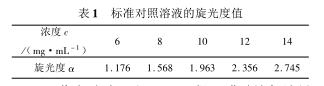
Accurately weigh 5.0g of danofloxacin mesylate reference standard, place it in a 50 mL volumetric flask, add an appropriate amount of water to dissolve, dilute to the mark, shake well, and prepare a solution with a concentration of 100 mg/mL. Then, take 6, 8, 10, 12, and 14 mL of the above solution respectively into 100 mL volumetric flasks, dilute to the mark with water, shake well, and prepare solutions with concentrations of 6, 8, 10, 12, and 14 mg/mL. Water was used as a blank, and the optical rotation was measured at room temperature. The specific results are detailed in Table 1. Through the analysis of the standard curve equation α=0.1965c-0.00212 (r=0.9998), it can be concluded that there is a good linear relationship between the optical rotation and concentration in the range of 6~14 mg/mL.
Stability test
Take the above solution with a concentration of 10 mg/mL, and leave it for 0, 1, 2, 4, 6, 12, and 24 hours. Water was used as a blank, and the optical rotation was measured at room temperature. The optical rotation values remained basically unchanged, indicating good stability.
Recovery test
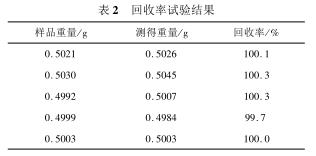
Take about 0.5g of danofloxacin mesylate sample from batch 020708, place it in a 50 mL volumetric flask, add 4.5g of glucose, dissolve it, dilute to the mark with water, shake well, and prepare a solution. After measuring the optical rotation, calculate the content according to the following formula and convert it to weight. The specific results are detailed in Table 2. The formula for calculating content is: Content %=(0.0108+5.09α)÷(1000xWx1/50)x100%.
The average recovery rate is 100.3%, with an RSD of 0.25%, indicating good recovery using this method.
Sample content determination
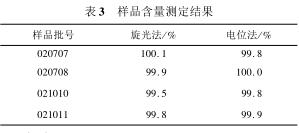
Take 0.5g of danofloxacin mesylate sample, place it in a 50 mL volumetric flask, dissolve it in water, dilute to the mark, shake well, and prepare the sample solution. Measure the optical rotation, and calculate the content according to the formula in step 3. Compare the results with those obtained by potentiometric titration, as shown in Table 3.
Results
In the concentration range of 6~14 mg/mL, danofloxacin mesylate showed a good linear relationship between optical rotation and concentration (r=0.9998). Compared with potentiometric titration, this method has the advantages of simplicity, speed, and ease of operation.
References:
[1] Li Dayan. Determination of danofloxacin mesylate content by optical rotation method. Chinese Journal of Veterinary Medicine, 2004, 38(1):30-31. DOI:10.3969/j.issn.1002-1280.2004.01.011.
[2] Wu Chunli, Zhang Qiurong, Shan Lihong, et al. Improvement of synthesis process of danofloxacin mesylate. Chinese Journal of Medicinal Chemistry, 2005, 15(6):354-356. DOI:10.3969/j.issn.1005-0108.2005.06.009.



 EN
EN
 Agricultural News
 Food News
 Industrial News
 Cosmetic News
 Pharmaceutical News
 Science News

 2YRS
2YRS